From Rifugio Quintino Sella to one of Monte Rosa’s most beautiful 4000-metre peaks
In brief
Castore is one of the most beautiful 4000-metre peaks in Monte Rosa, but it is not a climb to improvise. This story begins at Rifugio Quintino Sella and reaches the final ridge of Castore, with an IFMGA mountain guide, crampons, a rope team, effort and one simple discovery: you do not need to feel like a mountaineer to experience a real mountain, but you do need to arrive prepared.
I am not a mountaineer. I like walking, preferably when the sun is out, the temperature is mild and the effort stays within a reasonable range. But I am curious, I like stories, and I like understanding places before I cross them.
The decision to hike up to Rifugio Quintino Sella began like that: partly out of curiosity, partly from the wish to see one of Monte Rosa’s historic huts up close, and partly because some ideas, once they start turning in your head, eventually become a plan.
While reading about Rifugio Quintino Sella al Felik, I discovered that it is the starting point for the Castore climb with a mountain guide, one of the most beautiful 4000-metre peaks in Monte Rosa. An elegant, bright mountain, apparently close, but one that needs to be approached with preparation, attention and a mountain guide.
From that moment, Castore stopped being just a name on a map. It became a real possibility.
An accessible climb, but not an easy one
Castore is often described as one of the more accessible 4000-metre peaks in Monte Rosa. That is true when compared with other, more technical climbs in the massif. But accessible does not mean easy, and it certainly does not mean that you can improvise.
It is a real mountain. There is glacier terrain, crampons, a rope team, altitude and a final ridge that requires attention, a secure step and trust in the guide.
That is exactly why I decided to climb with a Monte Rosa mountain guide. I wanted to experience it without pretending to be something I am not. I wanted to put myself to the test, but in the right way.
Reaching Rifugio Quintino Sella was easier than I had imagined, but not without emotion. The approach takes about three hours and, in the final section, follows an equipped route that gave me a few shivers. I did it with Andrea, the guide who accompanied me, talking a lot and trying not to let fear take itself too seriously.
The first lesson came already there: some mountains look close on the map, but they still have to be reached one step at a time.
The night at Rifugio Quintino Sella
Rifugio Quintino Sella al Felik was exactly as I had imagined it: welcoming, warm, alive. A high-altitude hut with an important history and that special atmosphere you only find in certain places, when darkness arrives early outside and every table inside seems to have a departure to talk about.
I experienced it without too much tension, with a few conversations, a simple dinner and that lightness that belongs to evenings in mountain huts. You are together, even when you do not know each other. Some people prepare their gear, some check their boots, some speak quietly to save energy, and some try not to think too much about the alarm clock.
I almost forgot I was at 3585 metres.
The Castore climb is not something to improvise
The next morning Andrea woke me up at 4. I cannot say I welcomed the alarm with immediate enthusiasm, but in the mountains certain hours only make sense afterwards.
In about three hours we were on the summit of Castore. They were intense, clean, essential hours.
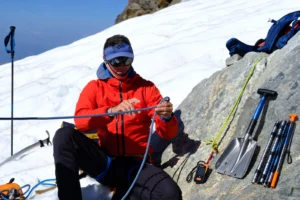
I learned not to catch my crampons in my gaiters, to hold the ice axe on the right side, and to trust the pace of the rope team. I was tired, of course. But it was an ordered kind of effort, full and proportionate to what I was experiencing.
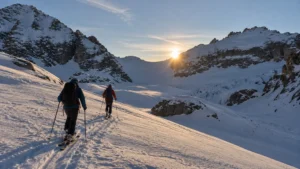
I looked down at Gressoney still asleep. I watched the sunrise climb in front of the Lyskamm. I searched for the lights of Capanna Gnifetti with my eyes. Then I reached the final ridge.
The ridge of Castore is one of those images that stays with you. Sharp, bright, airy enough to tighten your stomach and beautiful enough to make you continue.
Andrea taught me to move calmly, not to stiffen up, to give fear some order without letting it take all the space. That is one of the things a guide really does: they do not remove the mountain, they do not soften it, they do not turn it into something simple. They help you be there in the right way.
When I reached the summit, around me were the Matterhorn, Gran Paradiso, Mont Blanc, Monviso and the great peaks of Monte Rosa.
In that moment I had a very clear sense of how small we are. But also of how lucky we can feel when we have the privilege of being there, in the right place, with the right person, at the right moment.
Castore did not turn me into a mountaineer. But it gave me a real mountain. And for me, that was worth the whole climb.
Would you like to climb Castore with a mountain guide?
The ascent of Castore is suitable for those who have good fitness, experience hiking in the mountains and the desire to experience a more technical first 4000-metre peak, accompanied by an IFMGA mountain guide.
It is not a climb to improvise, but it can be a beautiful gateway into more conscious mountaineering: glacier terrain, crampons, rope team, altitude and a final ridge that requires attention, trust and a secure step.
If you would like to know the programme, prices and availability for the Castore climb with a mountain guide, you can contact us. We will help you understand whether this is the right mountain for you, at this moment.
The first step is not booking a summit. It is understanding whether that summit is right for you.
Useful reading
To prepare better, you can also read our guide on how to prepare for climbing Monte Rosa.
To learn more about the professional role of mountain guides, you can also visit the official website of the Italian Mountain Guides.