By the Monterosa Booking team, with IFMGA mountain guides from Monte Rosa
In brief
The mountain is not ours: it is a living, fragile and precious environment, made of rock, snow, water, animals, trails, huts, villages and people. Respecting it does not mean experiencing it less, but experiencing it better: with care, measure, preparation and awareness. Every gesture matters, because what we do at altitude does not concern only us, but also those who will come after.
There are places that do not need many words, and the mountain is one of them.
Arrive early in the morning, when the air is still cold and the trails are silent, and you understand that its beauty does not need to be explained
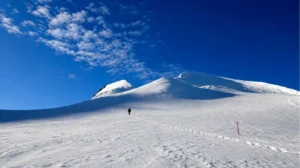
On Monte Rosa, as in many other alpine areas, every environment tells a story. With the IFMGA mountain guides from Monte Rosa, we learn every day that climbing does not simply mean reaching a summit, but moving through a place with care
The changing light, the glaciers that tell the story of time and climate change, the profile of the ridges, the trails where stones have been worn by generations of mountain people, hikers and mountaineers, the huts that recall the meaning of hospitality at altitude, the villages that preserve an ancient alpine culture: all this was not created to be consumed quickly, but to be experienced with respect..
The mountain has a beauty that does not shout. It reveals itself slowly, one step after another, and perhaps this is exactly why it is so precious.
It is a heritage, and a heritage is not used: it is cared for.
The mountain is a heritage, not a possession
The mountain is not just a view. It is not just a photograph to take home, a summit to tick off a list, or a place to reach in order to say “I was there”.
It is an environment made of rock, water, snow, animals, huts, meadows, woods, trails, villages, people who live there and people who pass through. It is fascinating and alive, but also fragile and complex
The mountain is made of balance, and that balance deserves respect.
Recognising this changes the way we move. It reminds us that every step, every choice and every behaviour leaves a trace, even when it seems small.
The mountain is precious because it is fragile
Those who spend time in the mountains know it well: very little is needed to change everything.
A late snowfall can transform an itinerary. A day that is too warm can make a glacier more delicate. A heavily used trail can be damaged. A piece of rubbish left on the ground can remain there for a long time. A careless decision can create problems not only for the person who makes it, but also for others.
When we speak about mountains, we often think of strength: walls, ridges, summits, glaciers, height gain. But the mountain is also fragility.
This fragility does not make it less great. It makes it even more important
When the gesture of a few damages a place for everyone
Sometimes, in the mountains, we see or hear about episodes that hurt: damaged structures, writing on rocks, broken signs, abandoned rubbish, disrespectful behaviour in huts or along trails.
These gestures may seem small to those who make them. Yet in the mountains, even a small gesture can weigh heavily.
Not because the mountain is an untouchable museum. The mountain is lived, walked, climbed and crossed. But living it does not mean taking possession of it. It means entering it with attention and respect.
Respecting the mountain does not mean experiencing it less
Respect is sometimes confused with limitation, as if respecting a place meant enjoying it less, feeling less free or constantly having to be careful about something.
In reality, the opposite is true
Respecting the mountain does not mean experiencing it less.
Those who respect the mountain experience it more fully, because they observe it better. They notice details, understand the value of silence, of the track, of rhythm and effort. They learn that not everything has to be fast, loud or immediate.
The mountain is not a place where we arrive and demand. It is a place we enter with measure: measure in our pace, in our words, in our expectations and in the way we behave towards the environment and towards other people.
This does not mean experiencing the mountain with fear or rigidity, but with presence. It means knowing where we are and remembering that we are moving through a place that existed before us and that, with a little care, will continue to exist after us.
The role of those who accompany people in the mountains
For us, accompanying people in the mountains does not only mean organising an ascent or reaching a summit.
A mountain guide is not simply someone who knows the way. A guide observes, assesses, decides and, day after day, passes on a correct way of being in the mountains.
Accompanying also means helping those who arrive at altitude understand that the mountain is not a backdrop to be used, but an environment to be crossed with respect.
A guide does not only accompany people towards a summit. They bring experience, responsibility and a mountain culture made of attention, measure and care.
In this sense, safety is part of respect. Knowing when to wait, change programme, turn back or choose a more suitable itinerary does not mean experiencing the mountain less. It means experiencing it with greater awareness.
To learn more about the professional role of mountain guides, you can also visit the official website of the Italian Mountain Guides.
Beauty is not guaranteed forever
When we walk towards a hut, cross a glacier or follow a trail, it often feels as if everything has always been there: the summits, the stones, the valleys, the snowfields.
It seems impossible that something could really change. And yet it does.
Glaciers change, seasons change, the ways in which people visit the mountains change, and so do the habits of those who pass through them.
For this reason, respect is not an abstract idea, but a concrete responsibility.
The beauty of the mountain is not guaranteed forever.
It is not enough to love it in words. We have to show it in the way we experience
Every time we choose not to leave rubbish behind, not to damage a place, not to shout where there is silence or not to insist when the conditions do not allow it, we are doing something small but important.
We are saying: this place matters.
Being guests, even when we feel at home
Those who love the mountains often say they feel at home there. It is a beautiful sentence, and partly true.
There are places that welcome us so deeply that they become familiar: trails we know, huts we return to, views that stay with us for years, sometimes for a lifetime.
But even when we feel at home, in the mountains we remain guests.
We are guests of a natural environment, of a story larger than our own, of places that do not exist to be consumed quickly.
A good guest does not demand, does not dirty, does not break and does not consume everything they find. A good guest is grateful, observes, adapts and leaves things in order behind them.
Perhaps respect for the mountain begins exactly here: by remembering that we are not the owners of everything we reach.
The mountain gives back what it receives
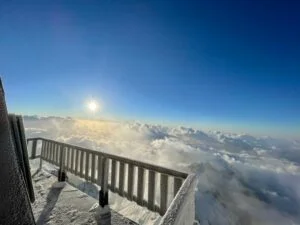
The mountain can be generous. It gives us days that stay in our memory, sunrises above the huts, deep silences, friendships born in a rope team, effort that becomes satisfaction and landscapes that feel too great to describe.
But to receive all this, we need to arrive with the right spirit.
You do not need to be an expert mountaineer to respect the mountain. You need education, attention, the ability to take a step back when necessary, and the awareness that the summit is not the only way to live a successful day.
The summit is not the only way to live a successful day.
Sometimes the mountain gives us the summit. Sometimes it gives us a lesson. Sometimes it simply asks us to come back another time. In every case, it deserves respect.
The mountain is not ours, but if we learn to care for it, it will continue to welcome us.
Would you like to experience Monte Rosa with more awareness?
On the Monterosa Booking blog, we tell the story of high altitude from the point of view of those who live it every season: preparation, safety, equipment, guide decisions and mountain culture.
We do not write to convince you to set off at all costs, but to help you understand where you are going, what to expect and how to prepare in the right way.
On the blog, we also explain how to choose your Monte Rosa equipment, because preparing well is a concrete form of respect towards yourself, the guide and the rope team.
Preparation also means honestly assessing your training for a 4000-metre peak on Monte Rosa without confusing desire with real readiness.
Subscribe to the Monterosa Booking newsletter to receive practical advice, reflections and useful content to prepare your next ascents on Monte Rosa with greater awareness.
Frequently asked questions about respecting the mountain
What does respecting the mountain mean?
It means visiting it with attention: taking your rubbish away, not damaging trails or structures, respecting huts and people, choosing suitable itineraries and accepting that the summit is not always possible.
Why is safety a form of respect?
Because in the mountains, a careless choice can involve guides, rope-team companions, hut staff and rescuers. Preparing well means protecting yourself and others.
Do you need to be an expert to experience the mountain with respect?
No. You need education, listening and awareness. Even those approaching the mountains for the first time can do it in the right way.