Shopping Cart

Activities

Mont Blanc 4,810 m — Italian Normal Route via Rifugio Gonella

Level: 5
Season: Summer
Duration: 2 days
Participants: Max 1

My goal

Two days of mountaineering on the Pope’s Route, the Italian normal route to Mont Blanc. A demanding climb across glaciers, exposed ridges and high-altitude terrain.

The Mont Blanc ascent via the Gonella Route, also known as the Pope’s Route, follows one of the great classic mountaineering routes in the Alps.

We’ll start from the Italian side, crossing the Miage Glacier to reach the Gonella Hut. The following day, we’ll make the long ascent to the summit of Mont Blanc, at approximately 4,810 metres.

Compared with the French normal route, this itinerary is less crowded and more demanding, both physically and technically.

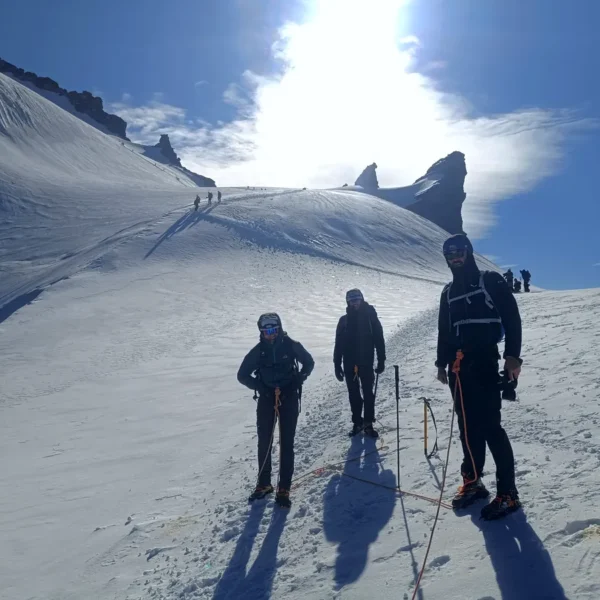
Along the way, we’ll cross crevassed glaciers, steep slopes and exposed ridges. You’ll therefore need mountaineering experience, good acclimatisation and the endurance to keep moving for many hours.

Our goal is to reach the highest summit in the Alps via the Italian normal route to Mont Blanc. Success depends on preparation, technical skills and mountain conditions.

Where you’ll go

We’ll start in Val Veny, near Courmayeur. From here, we’ll cross the Miage Glacier and climb to the Gonella Hut, at 3,071 metres, where we’ll spend the night.

The following day, we’ll set off during the night and follow the Pope’s Route towards the summit.

The classic itinerary climbs the Dôme Glacier to reach the Aiguilles Grises ridge. We’ll then continue towards the Piton des Italiens and the Dôme du Goûter.

After crossing the Col du Dôme, we’ll head towards the Vallot Shelter. From here, we’ll follow the Bosses Ridge to the summit of Mont Blanc.

If conditions require it, your guide may choose an alternative route along the Aiguilles Grises ridge, avoiding the Dôme Glacier.

After reaching the summit, we’ll begin the long descent. Your guide will choose the return route based on mountain conditions, timing and the energy available.

What you’ll need

The Mont Blanc ascent via the Gonella Route is suitable for experienced mountaineers with excellent physical fitness.

You must have previous glacier experience and have already climbed peaks above 4,000 metres. You’ll also need to know how to use crampons and an ice axe, and move confidently on snow, ice and mixed terrain.

On the first day, we’ll climb approximately 1,400 metres of elevation gain over 5–6 hours of walking.

The second day will be more demanding. From the Gonella Hut to the summit, we’ll gain around 1,740 metres, with an estimated ascent time of 7–9 hours.

Including the descent, you should be prepared for a mountain day lasting 14–15 hours or longer. The actual duration will depend on conditions and the return route.

Good fitness and proper acclimatisation are essential for this climb. You’ll also need to maintain a steady pace and save enough energy for the long descent.

How you’ll be guided

You’ll climb with an IFMGA Mountain Guide on a private, one-to-one basis.

Before departure, we’ll review your mountaineering experience, fitness and equipment. This will help us assess whether the route matches your abilities.

During the ascent, your guide will manage the pace, rope team and route choices. They’ll also assess snow, glacier and weather conditions throughout the climb.

The private format allows us to adapt the pace to your abilities, without having to accommodate other participants.

Reaching the summit is our goal, but it can never be guaranteed. Your guide will make the final decision about continuing based on mountain conditions and their professional assessment.

1 alpinist € 2100,00

The price includes

  • Two days with an IFMGA Mountain Guide
  • Half board at Rifugio Gonella
  • Crampons and climbing harness, if you do not have your own equipment

The price does not include

Personal mountaineering and mountain rescue insurance, meals and drinks not specified for you and your guide, transfers to the starting point, personal equipment, and anything not expressly listed under “The price includes”.

Day 1 — From Val Veny to Rifugio Gonella (3,071 m)

We will meet at 10:00 AM in Val Veny, near Courmayeur, to meet your guide, check the equipment and review the expected conditions for the ascent.

We will begin by following Val Veny towards the Miage Glacier. We will cross a long section of glacial moraine, walking over rocky debris and boulders before reaching the steeper part of the route.

Leaving the valley floor behind, we will continue over rocky terrain, alternating between mountain paths, equipped sections and passages requiring particular care. The final part of the climb will take us to Rifugio Gonella, at 3,071 metres, perched on a rocky spur above the glacier.

Once at the hut, we will settle in and spend the afternoon resting and preparing for the following day. We will check our technical equipment, assess the route conditions and agree on our departure time.

Dinner and overnight stay at Rifugio Gonella, 3,071 m.

Elevation gain: approximately 1,300 m
Walking time: approximately 5–6 hours

Day 2 — The Pope’s Route and the summit of Mont Blanc (4,810 m)

We will set off during the night, using our headlamps to take advantage of the generally more favourable conditions of the early morning.

From the hut, we will reach the Dôme Glacier and begin travelling roped together, negotiating crevasses and glacial slopes. Our route will depend on glacier conditions, which can change significantly throughout the season.

We will climb towards the Col des Aiguilles Grises and continue along the ridge leading to the Dôme du Goûter, at over 4,300 metres.

From here, we will reach the Col du Dôme and the area around the Vallot shelter, at approximately 4,360 metres, before beginning the final section of the ascent.

We will follow the Bosses Ridge, negotiating exposed snow sections and slopes requiring concentration, confident crampon technique and a steady pace. Beyond the final rises of the ridge, we will reach the 4,810-metre summit of Mont Blanc, provided conditions allow.

After a short break, we will begin our descent. We will choose the most appropriate route according to mountain conditions and the state of the available descent itineraries. We may descend by the ascent route or follow an alternative itinerary, if feasible and agreed with the guide.

This will be a long and physically demanding day. We will need to conserve enough energy for the descent, which is an essential part of the climb.

Elevation gain: approximately 1,740 m to the summit
Elevation loss: varies depending on the descent route
Walking time: approximately 10–12 hours, depending on conditions and the chosen descent route.

For the Mont Blanc ascent via Rifugio Gonella, you will need:

  • mountaineering clothing suitable for high altitude and very low temperatures
  • insulated mountaineering boots compatible with crampons
  • 35–40 litre backpack
  • mountaineering helmet
  • classic mountaineering ice axe
  • category 4 mountaineering sunglasses
  • headlamp with spare batteries
  • sleeping bag liner for the overnight stay in the hut

Crampons and a climbing harness are provided by us. If you have your own equipment, we recommend bringing it, provided it is suitable for the ascent. Please check with us before departure regarding the helmet and ice axe you will use.

After booking, we will send you a complete and detailed equipment checklist with specific recommendations for your Mont Blanc ascent. You can also consult our mountaineering equipment guide.

Mountaineering, ski touring, off-piste skiing and trekking take place in a natural, uncontrolled environment.
Weather conditions, snow, ice, terrain, visibility, altitude and physical fatigue can change rapidly and directly affect the course of the activity. For this reason, there is always an inherent level of objective risk, which cannot be eliminated but only managed.

All our activities are led by IFMGA Mountain Guides and Certified Hiking Guides (AMM).
The guide continuously assesses environmental conditions and the physical and mental state of participants, sets an appropriate pace, manages progression and ensures the correct use of equipment. If conditions require it, the guide may modify the itinerary or interrupt the activity, always in the interest of individual and group safety.

Participants are required to be in good physical and mental condition, adequately prepared for the level of the activity, and to follow the guide’s instructions at all times.

Group activities

During group outings, the pace is set according to the slowest participant. In case of fatigue or discomfort, the guide may decide to adjust the programme or return early. In the mountains, the group ascends and returns together.

? Learn more here

**FAQ #1** – Can I climb Mont Blanc via Rifugio Gonella without previous mountaineering experience?

No. The Gonella Route is a demanding mountaineering itinerary intended for climbers with previous experience on glaciers and peaks above 4,000 metres. You must be confident using crampons and an ice axe, travelling roped together and managing long days at high altitude. Before confirming the ascent, we will review your mountaineering experience.

**FAQ #2** – How fit do I need to be for this ascent?

You need excellent physical fitness. On the first day, we will climb approximately 1,300 metres to Rifugio Gonella. On summit day, we will leave during the night and ascend approximately 1,740 metres to the summit, followed by a long descent. You should be accustomed to walking for many hours on alpine terrain and arrive properly acclimatised.

**FAQ #3** – Why is the Gonella Route more demanding than other normal routes?

The Gonella Route involves a long approach, complex glacier terrain and a considerable elevation gain on summit day. It is less frequently travelled than the French normal route and requires greater confidence moving through glaciated terrain. The difficulty also depends on conditions on the Dôme Glacier and the state of its crevasses.

**FAQ #4** – Where will we sleep, and what does the overnight stay include?

We will stay at Rifugio Gonella, at 3,071 metres, on the Italian side of Mont Blanc. The programme includes half board: dinner, overnight accommodation and breakfast. We will depart for the summit during the night, at a time determined by the guide.

**FAQ #5** – What technical equipment should I bring?

We provide crampons and a climbing harness, although we recommend bringing your own if you have suitable equipment. You will also need a helmet, ice axe, insulated mountaineering boots and clothing designed for very low temperatures. We will review the equipment requirements together before departure.

**FAQ #6** – Will we descend by the same route?

Not necessarily. We may descend via the Gonella Route or use an alternative itinerary if conditions allow. Your guide will choose the most appropriate option, considering the weather, glacier conditions, snow and your physical condition. Any planned alternative descent will be discussed before the ascent.

**FAQ #7** – What happens if conditions prevent us from reaching the summit?

Reaching the summit cannot be guaranteed. Weather, glacier conditions, snow, wind and physical condition may require us to modify or stop the ascent. Your guide will make the necessary safety decisions. Any refund or credit will be subject to the applicable booking conditions.

Populate the form and secure your spot now!
Choose your departure date

Mont Blanc 4,810 m — Italian Normal Route via Rifugio Gonella

€0.00


Insurance

Before departure, check that your insurance policy specifically covers mountaineering, glacier travel, altitude, trip cancellation, repatriation, and personal liability. For more information, read our complete guide to mountain insurance.

WINTER

Level 1 – Explore
First freeride experiences. Controlled turns and a relaxed pace on accessible terrain.

Level 2 – Advanced
Confident skiing on ungroomed snow and able to maintain a good pace throughout the day.

Level 3 – Technical
Regular freeride experience, including on steeper terrain and in more exposed situations.


SUMMER

Level 1 – First experience
You should be comfortable with normal mountain hiking. No previous mountaineering or glacier experience is required.

Level 2 – Basic experience
You should already have completed hikes of several hours on mountain trails. Previous glacier experience or use of crampons is not required, but you should be ready to use them for the first time.

Level 3 – Mountaineering experience
Previous experience using crampons and travelling roped together on a glacier is required. The route may include short exposed sections.

Level 4 – Advanced experience
Solid experience using crampons and travelling roped together is required. The route may include exposed ridges, steep slopes and mixed terrain.

Level 5 – Experienced mountaineer
Strong experience on technical high-mountain routes is required. The route may include very exposed sections, climbing on rock, ice or mixed terrain, and may require knowledge of the main rope techniques.

The level indicates the technical experience required, not the physical effort.
The actual difficulty may vary depending on mountain conditions and the route.