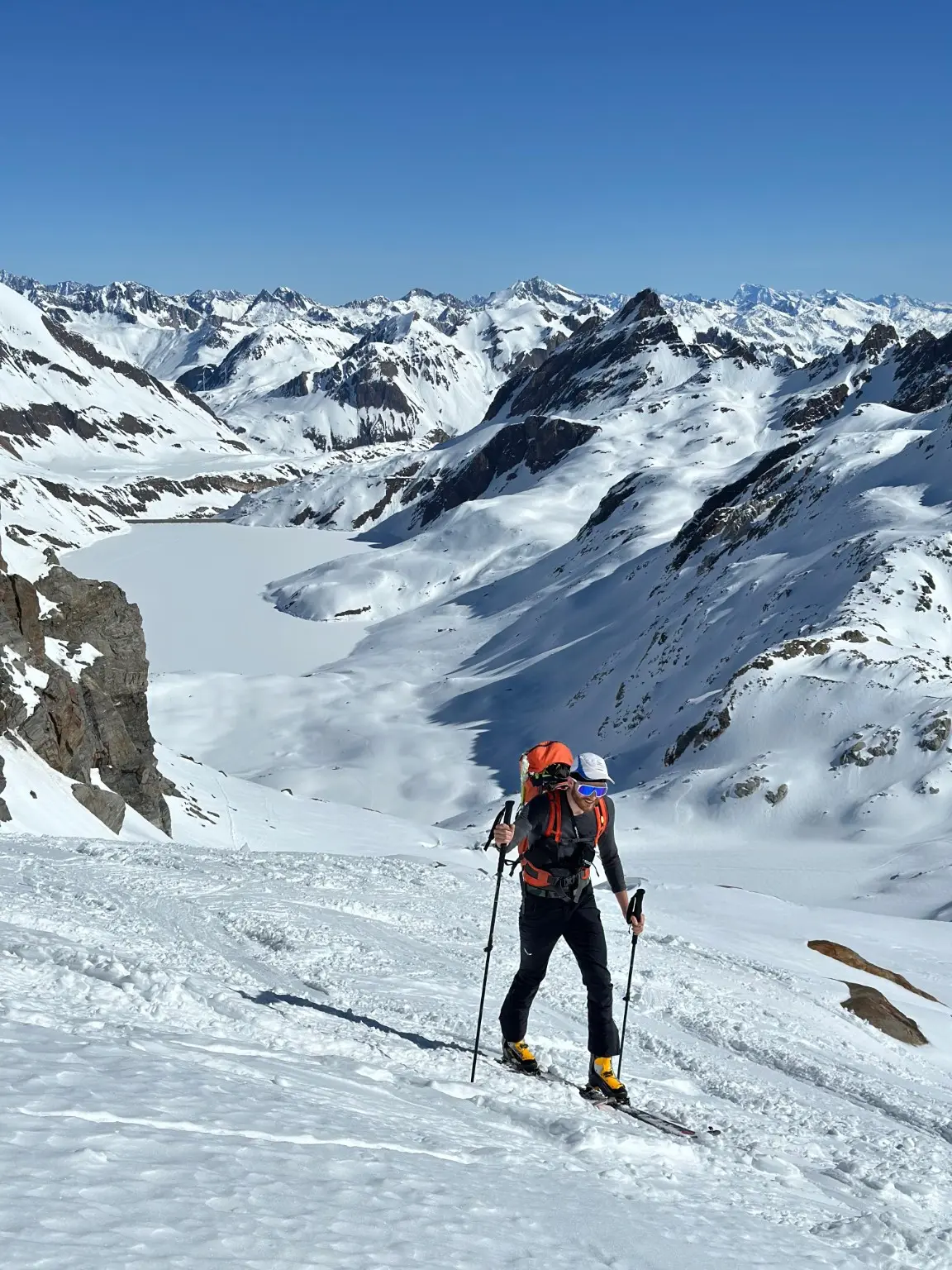
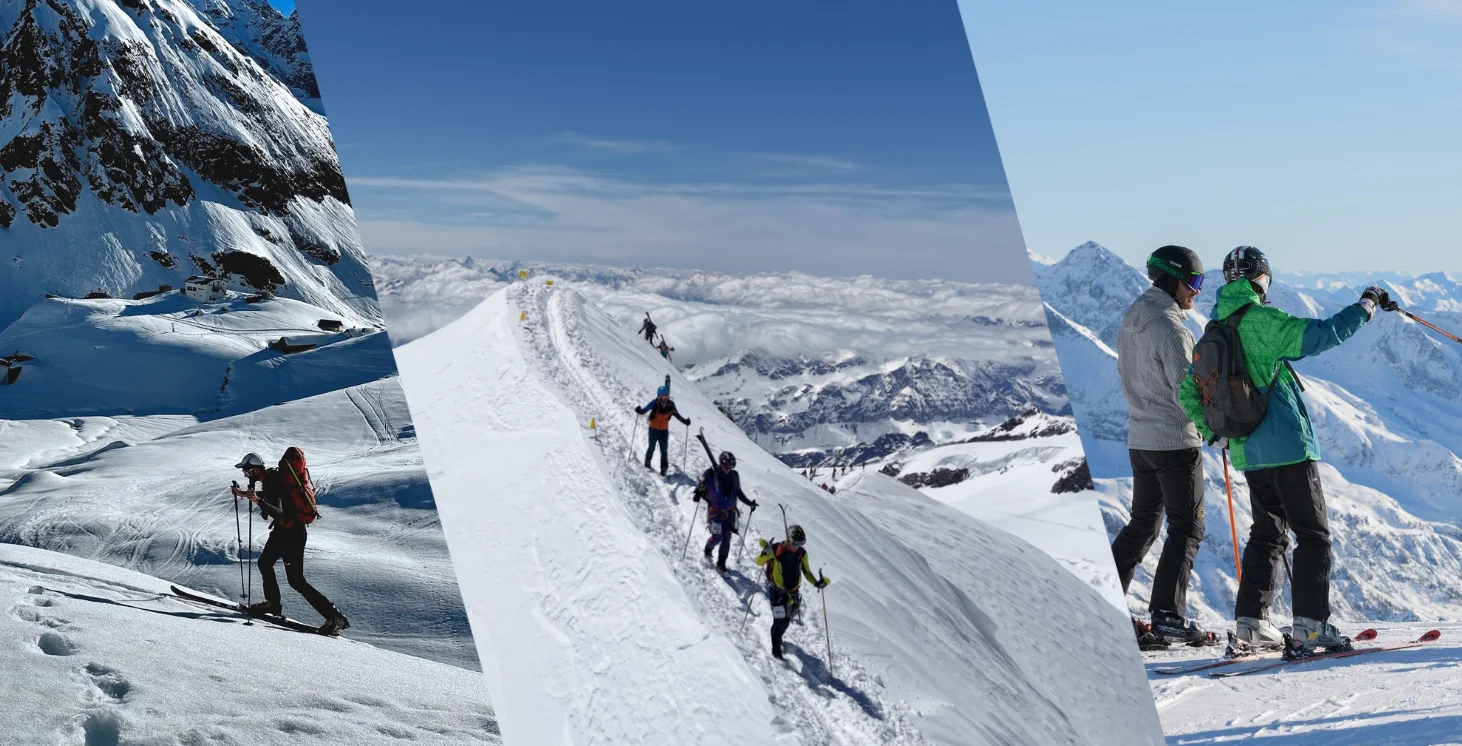
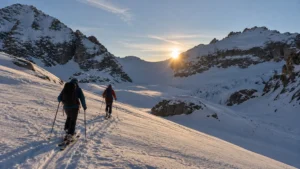
The first time you attach skins to your skis, you discover something rather wonderful: you can ski uphill. Your heels lift, your skis slide forwards and the skins grip the snow, stopping you from slipping backwards. Your movements feel a little awkward at first, but soon you begin to find your rhythm.
The skin track winds uphill, the sound of the lifts fades into the distance and, almost without noticing, you start to see the mountains differently.
You stop, turn around and look back at how far you have come. You have only just started climbing, but one thing is already clear: on skins, getting there is part of the fun.
We asked IFMGA mountain guide Andrea Greggio what he would say to persuade a friend to try ski touring.
His answer came straight away:
“Come along. You’ll love it.”
A simple invitation that captures the enthusiasm of someone who loves what he does.
So what makes ski touring so special? And what can you expect if you have never tried it before?
The pleasure of climbing, one step at a time
We tend to associate the pleasure of skiing with the descent: the speed, the turns, the snow beneath our skis. Ski touring introduces you to the enjoyment of everything that comes before it, too.
The climb has a rhythm of its own.
You learn to slide your skis rather than lift them, to choose a line across the slope and to pace yourself. Your steps become more consistent, your movements gradually more fluid.
As the terrain gets steeper, you try your first kick turns: the changes of direction that allow you to zigzag up a slope. At first, they take concentration, a few attempts and perhaps a laugh when your skis seem to have ideas of their own.
Little by little, it starts to feel more natural.
Your legs are working, your breathing settles into a rhythm and the landscape changes around you. You do not have to reach a major summit. Even a short tour can give you the satisfaction of gaining height under your own steam.
And on a clear, sunny day, with the snow crunching beneath your skis, even the effort can become part of the pleasure.
The same mountains, a different world
For IFMGA mountain guide Luca Avagnina, one of the best things about ski touring is the freedom to explore the mountains in winter.
Places you know well in summer look completely different. Paths disappear beneath the snow, slopes are transformed and valleys take on new shapes and perspectives.
Luca describes “mountains that feel a little different, even though they’re the same ones.”
It is a lovely way of capturing the pleasure of returning somewhere familiar and discovering it afresh.
As you gain experience, ski touring can open up opportunities to reach summits, cross valleys, link routes and ski slopes far from the resorts.
This is precisely what Andrea Greggio enjoys: reaching places the lifts do not serve and, when the route and conditions allow, spending a day away from the crowds.
Luca adds another ingredient: the search for the best snow. He describes the pleasure of breaking trail up a valley with a few friends or fellow guides, reaching remote places where the conditions can be wonderful.
“Wherever your nose for powder takes you.”
Of course, a nose for powder is not enough on its own. Snow conditions, terrain, weather and the group’s abilities determine which routes make sense.
But the search itself, the anticipation of discovering what the snow will be like and the chance to leave your own turns on an untouched slope are all part of the appeal.
The pleasure of small things
There is another side to ski touring, perhaps less spectacular, that deserves a little attention.
Imagine arriving at a small mountain hut after the climb. The sun has warmed the timber wall. You take off your rucksack, unzip your jacket and sit down with your back against the warm wood.
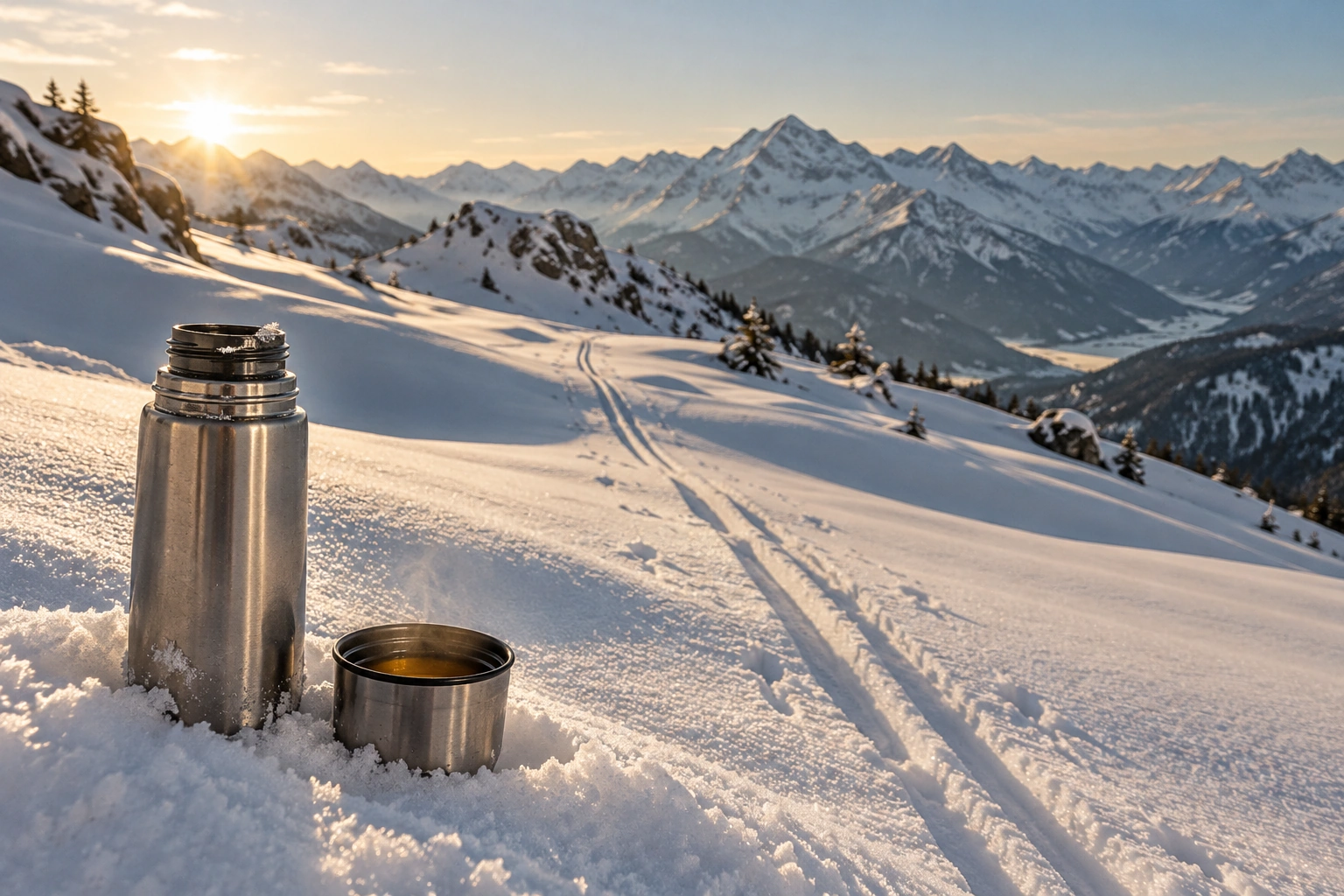
Skis stand upright in the snow. Someone pulls out a sandwich; someone else pours tea from a flask.
In front of you are the mountains, the white of the snow and the winter light. You settle into the break, chatting with your companions and enjoying the satisfaction of having made it this far.
There is no rush to move on.
This, too, is part of a day on skins.
IFMGA mountain guide Teodoro Bizzocchi particularly loves what he calls “the quiet solitude”.
When we asked which moments make him happiest on a ski tour, he described something very simple: moving across level ground, his skis sinking just a little into the snow and gliding lightly over the frozen crystals. A shaft of sunlight appears above the ridge, making him narrow his eyes, and a hare’s tracks emerge in the snow.
“A hare’s tracks cross my path… I can’t bring myself to disturb them… That’s when I feel alive.”
Teodoro is the poet among us. A few simple movements, snow and light.
Small details like these can stay with you as vividly as a beautiful descent. Ski touring gives you time to notice them, because so much of the day is spent moving slowly uphill through the landscape you will later ski down.
Time to take the skins off
Then comes a moment many skiers particularly look forward to: the end of the climb.
IFMGA mountain guide Alberto Zucchetti describes it so vividly that you can almost imagine being there.
You reach your destination, take off your rucksack, change out of your sweaty base layer and pull on a down jacket before you get cold. You have something to eat, drink from your flask and chat with your companions, taking in the view.
Then comes the little ritual of getting ready for the descent: peeling off the skins, packing them away, switching the bindings to downhill mode and adjusting your boots.
For an experienced ski tourer, these movements become second nature. On your first outing, they are still part of the discovery.
And finally, you set off.
Alberto makes no secret of the part he finds most rewarding:
“The descent. When the snow is good, it’s pure joy. You don’t want to stop until you reach the car.”
When your skis float through soft snow and one turn flows naturally into the next, the satisfaction of the climb takes on a new dimension.
Alberto says that even when he would happily keep skiing without a break, he does stop now and then. He looks back at the tracks he has just left, takes in the landscape and tries to make the feeling last a little longer.
Then it is time to ski on, right down to those final turns.
And in his telling, the day does not end when the skis come off. There is still the pleasure of a beer at the bar with the friends who shared the tour.
It is a lovely picture of ski touring. A single day holds the effort of the climb, the chance to take in the mountains, the anticipation of the descent and the pleasure of good company.
You will not always find perfect snow. But when you do, it is easy to understand why people keep looking for it.
I’d love to try it, but will I manage?
It is one of the most natural questions to ask if you are coming from piste skiing.
The answer depends mainly on your skiing ability, your fitness and the route you choose.
You do not need to know how to use skins before you start. You can learn how to attach them, just as you can learn the uphill technique, kick turns and how the bindings work.
What matters is having a sound downhill skiing technique.
Luca Avagnina places particular emphasis on this. Skiing on piste remains valuable even for people who regularly ski off-piste. It helps keep your technique sharp and your skis under control, which becomes especially useful when the snow is difficult.
Because the descent will not necessarily be through the light powder you have seen in videos.
You might encounter firm snow, crust, wind-deposited snow or uneven surfaces. You need to be able to manage your skis even when conditions are less than ideal.
As Teodoro reminds us with a touch of humour, the descent can sometimes become a challenge we would rather have done without.
If you have only ever skied on groomed pistes, it is worth assessing how you cope with ungroomed snow first. We explore this in our article I ski well on piste: am I ready to go off-piste?.
How fit do you need to be?
The climb involves sustained effort, quite different from alternating ski runs with chairlift rides. It helps to be used to walking in the mountains and able to keep a steady pace for a few hours.
You do not need to be an athlete, but you do need to choose a suitable amount of ascent, remembering that you still have the whole descent ahead of you.
A well-planned first outing gives you time to learn, take breaks, look around and get comfortable with the activity.
There is no need to start with a major traverse.
Your first ski tour: what you need and where to begin
One of the most common questions concerns equipment. How much do you need to buy just to give it a go?
The good news is that you do not need to invest in a complete set of equipment for your first outing.
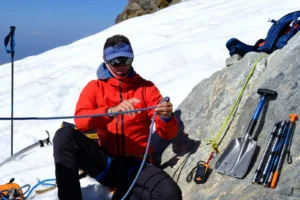
Touring skis have bindings that allow your heels to lift on the way up and secure them for the descent. Skins attach to the bases of your skis, providing grip for climbing snowy slopes. Your boots need to be compatible with the bindings and suitable for both walking and skiing.
You will also need poles, clothing suited to the effort of climbing and a rucksack carrying what you need for the day. Depending on the terrain and conditions, additional technical equipment may be necessary.
For your first experience, consider hiring skis, boots and skins, checking availability and making sure everything is compatible in advance.
There is another point that deserves particular attention: ski touring takes place in terrain where avalanche risk needs to be assessed with the right knowledge and experience.
An avalanche transceiver, shovel and probe are standard avalanche rescue equipment, but simply carrying them is not enough. You need to know how to use them, practise and learn to interpret information about the snow, terrain and avalanche danger.
Even a route that looks easy can involve hazards that are not obvious to a beginner.
This is where a mountain guide’s work comes in: assessing conditions, choosing a route suited to the group, teaching the basic techniques and adapting the plan when necessary.
When Andrea Greggio takes someone out on skins for the first time, for example, he looks for favourable conditions and a route that gives them plenty of opportunity to enjoy themselves and learn.
A private day with a guide can be an excellent way to start, whether on your own or with a few friends of a similar ability and with similar expectations. The pace and practice sessions can be tailored to you, leaving room for questions and those first attempts.
An introductory course in a small group is another way to build the basics and meet other people who share your interest.
What if you love it?
Talking about people who have tried ski touring, Luca Avagnina told us:
“I don’t know anyone who’s tried it and hasn’t fallen in love with it.”
That is his personal enthusiasm speaking, of course. Ski touring does not have to be for everyone. Some people mainly enjoy the descent, some prefer using the lifts and others discover an unexpected pleasure in climbing.
But that is the lovely thing about giving it a go.
You might discover that you enjoy the steady rhythm of skins on snow. Perhaps it will be the satisfaction of reaching somewhere under your own steam, or the feeling of floating through those first turns on an untouched slope.
And perhaps, over that beer with friends at the end of the day, you will already be thinking about where to go next.
If you would like to try ski touring, tell us about your skiing, how used you are to walking uphill and any experience you have on ungroomed snow. We can help you choose a ski touring course or a first outing with an IFMGA mountain guide, with a programme suited to your abilities and the conditions.