Some mountains can be understood by looking at a map. Monte Rosa asks for something more.
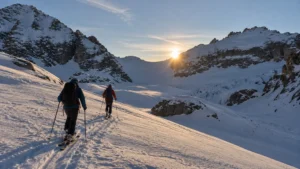
You need to know its slopes, the way the glacier changes, the early-morning starts from Capanna Gnifetti or Rifugio Mantova, the long descents, the days when the wind changes the pace of the rope team and the mornings when the snow, already by mid-morning, tells you it is time to head down.
Those who arrive in Alagna, Gressoney or Ayas to climb a 4000-metre peak on Monte Rosa bring an objective with them.
Sometimes it is their first ascent at high altitude. Sometimes it is a ridge they have imagined for years. Sometimes it is the wish to return to a place they already know, with a more mature eye and a different kind of preparation.
This is where our work begins: helping you turn that wish into a sensible path, with the right guide, the right period and the programme best suited to your level.
We work with IFMGA mountain guides from Monte Rosa: professionals who live and work on this massif season after season. Guides from Alagna, Gressoney, Ayas and Macugnaga, used to reading real conditions, choosing the best tracks, and understanding when to continue and when to stop.
Because in high mountains, the summit matters. The way you get there matters too.
In brief
Climbing Monte Rosa with a mountain guide means relying on someone who knows the massif, the glacier conditions, the lift logistics, the huts and the real pace of a rope team. The right person helps you choose the itinerary, assess the best period, understand your level and make responsible decisions along the way.
Why a Monte Rosa guide makes the difference
A route description written years ago can give you a general idea, but it is not enough to decide whether an ascent makes sense today. You need an up-to-date reading of the terrain. You need experience. You need someone who can interpret what they see.
This is exactly what a mountain guide brings: technical competence, knowledge of the place and the ability to make decisions when they matter.
Going into the mountains with a Monte Rosa guide means relying on someone who knows the rhythm of days at altitude.
This is often the invisible part of the work. And it is the part that really makes the difference.
The right guide for your objective
For us, choosing a guide does not simply mean checking availability in a calendar.
Every client has a different level, a different background and a different way of moving in the mountains. Some have already climbed several 4000-metre peaks and are looking for a more technical ridge. Some come from trekking and want to approach mountaineering carefully. Some are fit, but have no glacier experience. Some need a patient approach, some prefer a more technical style, and some want to climb with someone who speaks their language.
Our role is to build the most appropriate match between guide, client and objective.
A rope team works when there is trust. The person leading the ascent reads the terrain, of course, but also reads the person in front of them.
At altitude, this relationship matters.
The ascent begins before departure
A good ascent begins before the day you set off.
It begins with the right questions: What experience do you have? How do you train? Have you already used crampons and a harness? How do you react to altitude? What do you really want from this ascent?
From there, the programme is built.
This is why the work of Monte Rosa mountain guides starts well before departure day. It is not just about leading a rope team towards a summit. It is about understanding whether the objective is coherent, whether the timing is right, whether the preparation is sufficient and whether the chosen route makes sense for that person, at that moment.
The classic climbs on Monte Rosa
Monte Rosa offers some of the best-known ascents in the Alps.
Capanna Margherita, at 4554 metres on Punta Gnifetti, is often the first major objective for those who want to climb at high altitude. It is accessible to those who are well trained and well prepared, but altitude, cold, glacier terrain and duration must not be underestimated.
Piramide Vincent and Punta Giordani are often chosen by those who want to approach 4000-metre peaks with a shorter itinerary, starting from the Indren lifts. They are good ascents for beginning to understand glacier progression, the pace of the rope team and the use of crampons. They are often the first real step into mountaineering.
Castore, with its elegant and airy ridge, requires a more secure step and greater confidence in the alpine environment.
Polluce, the Naso del Lyskamm, the ridges of Monte Rosa and the more technical traverses belong to a different level: they require preparation, experience and careful choice of conditions.
Every ascent has its own character. That is why we do not suggest the same route to everyone.
Monte Rosa offers many possibilities, but the right choice depends on the person, the season and the moment.
When the objective is to grow
Many people come to Monte Rosa because they want to learn something, not simply add another summit to their list.
A day on the glacier, a progressive ascent or a technical itinerary can become important steps towards building autonomy, awareness and safety.
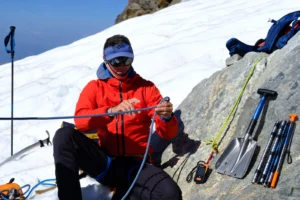
Learning to walk with crampons, manage the rope, use an ice axe, move on firm snow and understand how to travel in a rope team are all part of a real Introduction to Mountaineering on Monte Rosa. These are skills that change the way you experience the mountains.
In these cases, the guide does more than accompany you: they teach, observe, correct and help you understand, without pushing too hard and without oversimplifying.
For us, this is central. The mountain needs to be prepared for, understood and respected. Even when the objective seems “easy”.
Beyond the summit
A successful ascent is not measured only by the summit photo.
A successful ascent is seen in the way you managed the day: in the preparation you brought with you, in the trust you were able to place in the guide, and in the way you accepted the right pace, the weather, the conditions and the decisions made along the route.
Sometimes the best choice is to continue. Sometimes the best choice is to turn back. In the mountains, both require presence, experience and measure.
IFMGA mountain guides work exactly on this boundary: helping you live a full experience while keeping the safety of the rope team at the centre.
Their competence lies in knowing where to pass, when to change the programme, when to slow down and when to suggest an alternative.
Monte Rosa teaches a great deal to those who listen to it. It teaches measure, patience, preparation and respect. It teaches that the summit matters, and that the way you reach it says much more.
Where to begin
If you are thinking about Capanna Margherita, Castore, your first 4000-metre peak or a more technical ridge, the first step is to understand where you are starting from.
We help you choose the most suitable itinerary, assess the best period, and organise the guide, huts, lifts, technical equipment and logistics. We also help you understand whether the programme you have in mind is coherent with your current level, or whether it would be better to build a more gradual path.
This, for us, is what it means to work well on Monte Rosa.
If you want to climb Monte Rosa and are not sure which itinerary to choose, we can help you assess your level, the right period and the most suitable guide.
Write to us: the best path always begins with a calm, well-considered choice.
To learn more about the professional role of mountain guides, you can also visit the official website of the Italian Mountain Guides.
By the Monterosa Booking team, with the support of IFMGA mountain guides from Monte Rosa