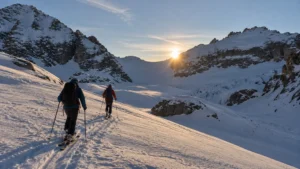
No cable cars, no mountain trains, no queues. Just you, your guide, and the powerful silence of Mont Blanc’s most Himalayan side. It’s an experience for those who aren’t looking for shortcuts, but who want to savour every step, every crevasse, every sunrise.
You prepare for goals like this with intelligence. It’s not about brute strength—it’s about rhythm, method, and listening. And it all starts early—Mont Blanc in June is still quiet, and the high spaces are less travelled.
Why climb it this way?
You don’t need heroic reasons. Mountaineering isn’t a challenge—it’s a language. It requires desire, consistency, training, and patience. And then, listening: to the mountain, to your body, to your rope team. Climbing brings clarity to your thoughts. It slows you down, sharpens your focus, and clears away everything that doesn’t matter.
And June is when everything is still possible. No summits have been “done” yet. No trail is set. Just an authentic world waiting—and the perfect time to step outside the everyday. Without leaving a trace.
The right moment is now
In May, with this year’s abundant snowfall, Mont Blanc prepares quietly. A thick, gentle blanket of snow muffles all sound and paints an unmoving scene. Beneath it, the glacier compacts, settles, and takes shape. The stage is set—the theatre of alpine climbing reopens.
For those who go to the mountains with both head and legs, it’s clear by now: Mont Blanc in June is the key. Even though many still insist July is best, recent years tell a different story. In June, the glaciers are still well-covered, temperatures are stable, melt channels haven’t yet carved the surface, and snow bridges hold. The terrain is white, intact, readable.
Climate change: what we see on the ground
Global warming isn’t just theory—it’s visible on every outing. July, once the ideal month, has become risky. Temperatures spike too early. Rockfall increases, seracs shift, teams climb at night—or not at all. Good weather windows are getting shorter.
June still offers a margin. Colder nights, more snow, less stress. We just need to adjust our habits. Rethink the calendar. Focus on the present, not the past. The new season starts now.


The climb: day by day
Day 1
We begin from Val Veny, hiking across the old moraine of the Miage glacier—a mineral, lunar landscape that invites a meditative pace. There’s no marked trail: we pick our way through shifting rocks, slowly and attentively.
At around 2700 m, the scenery shifts. A narrow exposed traverse leads to a fixed section, which finally brings us to the Gonella Hut—clinging to the rock with a stunning view of the Eiger and the heart of Mont Blanc.
Ascent: about 1300 m. Duration: 4.5 to 5 hours. After dinner, it’s straight to bed—the alarm is set for midnight.
Day 2
We begin the summit push at 1 a.m., retracing the previous day’s traverse, this time in crampons. The surroundings are grand and austere. We cross the Dôme glacier, navigating wide crevasses and fragile snow bridges. The ascent is long and steady, demanding a solid pace.
From Col des Aiguilles Grises, a steep snow slope brings us to the ridge of the Piton des Italiens. A few easy climbing sections lead to the long snowy ridge that reaches the Dôme du Goûter.
Here, we merge with the French normal route. If all goes well, the sunrise greets you near Vallot Hut at 4350 m—a moment you’ll never forget. The sun rises, and the summit begins to feel within reach.
The Bosses Ridge, with its iconic humps, leads to the very top. Breathing is harder, but the view opens, widens, and reveals itself step by step. Reaching the summit brings joy, emotion—and a well-earned fatigue.
The descent and the value of slow time
The descent still demands effort and focus. You may return via the Aiguille du Midi or follow the French normal route. For the fittest, it’s also possible to descend back the way you came.
If your legs allow, you can head down to the valley the same day—but spending an extra afternoon and night at the hut often makes the experience unforgettable. Descending the next morning, with sunlight filtering through the seracs and the ice cracking underfoot, brings a fullness that rushing never could.
When the mountain becomes yours too
Climbing Mont Blanc via Gonella means real mountaineering—where solitude is your ally, fatigue your companion, and each step creates a lasting memory. Maybe June 2025 is your time.
Write to us to organise your climb with an experienced IFMGA guide—offering technique, trust, and passion to support the mountain dream that’s truly yours.
Ready to climb Mont Blanc in June? Click Here
Monte Bianco via the Gonella hut: meet the author
Riccardo “Ioris” Turini is a mountain guide based in Gressoney. Born in Montanaro, with the plains behind him and Monte Rosa in his heart, he has made the mountains his home. For many years, he led the Gressoney mountain guides, helping to shape a strong and passionate alpine community. Calm, thoughtful, and quietly determined, he’s known for his energy, his drive to go further, and his ability to find beauty in the unexpected. He’s passionate about kintsugi, beekeeping, trout, and meaningful words. For Riccardo, the mountains are not just a destination—they are a space for growth, change, and connection.