Silence in the mountains: what happens when you stay
Silence in the mountains is something that emerges when you stop filling every space. It doesn’t arrive immediately; it takes time and, at first, it can create a sense of suspension. Then it changes nature. It becomes presence. It becomes a place where you begin to see more clearly, without filters, without noise.
In the mountains, this shift happens naturally. Not because it is a special place in an abstract sense, but because it brings you back to what matters. Words decrease, thoughts slow down, movements become simpler. What remains is your step, your breathing, the effort. Within this rhythm, something realigns. It is a different way of being.
Silence is freedom. Freedom from the constant need to react, respond, prove something. Freedom from the noise that builds up without you noticing. In a world that pushes you to always be present and always active, silence in the mountains becomes a rare and valuable space.
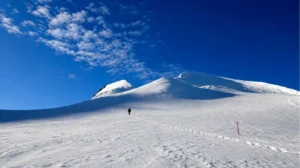
High altitude on Monte Rosa
The truth is that we are no longer used to it. We no longer know how to stay in a space without filling it. Every empty moment becomes an opportunity to add something: a screen, a notification, a piece of content. The result is a subtle, constant fatigue. It does not come from what we do, but from what we never stop doing.
Silence in the mountains interrupts this cycle. It does not introduce anything else; it stops it.
And this is exactly where the difficulty lies: stopping also means seeing.
Seeing what usually remains covered by noise. Half-finished thoughts, accumulated tensions, postponed questions. It is not always pleasant, but it is real.
At altitude, this process becomes inevitable. Distractions decrease, the environment demands attention, the body asks for presence. Space simplifies. Step by step, a different condition is built: less reactive, more attentive; less full, more essential. Silence changes form and becomes something that supports you.
With a mountaineering experience on Monte Rosa, this is still possible. On ridges, on glaciers, in mountain huts, time expands and things return to their proper scale. It is enough to stay long enough for the rhythm to change.
What is surprising is what remains afterwards. Silence continues to work even when you return. You notice a more attentive listening, more measured reactions, a more stable presence. It is a subtle change, but a concrete one.
The mountain becomes a place where you can see more clearly. To distinguish what truly matters from what simply fills space.
Monterosa Booking was created around this idea: to create the conditions for this shift to happen. An ascent, a hut, a night at altitude are tools. What happens next is personal.
Sometimes a simple decision is enough: to take the time to stay. And let silence do its work.
The mountaineering season on Monte Rosa
At the beginning of the season, Monte Rosa is different. Not because the mountain changes, but because the way you move within it changes. The days start early, with a colder light. The huts are quieter, the glacier is clearer, easier to read. The pace is slower, more essential.
You are more present.
For this reason, it becomes easier to understand where you really are: whether something is missing, whether you are ready to take a step further, or whether you simply want to stop and give a clearer direction to what you are doing.
In this period, some ascents support this process better than others, if you want to find your rhythm from the very beginning.


Recommended climbs on Monte Rosa in June
June 12–13–14 — Basic Mountaineering Course
Three days on the glacier to build solid foundations: crampons, rope work, pacing.
Useful to start with the right approach or to refine what still feels uncertain.
June 13–14 — Punta Parrot, Ludwigshöhe, Corno Nero (2 spots)
Two continuous days above 4000 m. Three peaks, no real breaks.
A Monte Rosa ascent for those who already have experience and want to stay at altitude with rhythm and continuity.
June 13 — Piramide Vincent (1 spot)
A clean, direct 4000 m peak.
The clearest way to understand how you react at altitude.
June 20 — Castor Peak (2 spots)
A true ridge. More focus, more precision in movement.
For those who want to take a step further with awareness.
June 25 — Capanna Regina Margherita (classic route)
Reaching 4554 metres in one of the best periods of the season.
Direct line, steady pace, complete experience.
June 26–27–28 — Capanna Regina Margherita with overnight (2 spots)
You climb and you stay.
Sleeping at altitude changes how you perceive effort, time and space.
There isn’t a right choice for everyone.
There is the one that makes sense for you, right now.
If something you’ve read made you pause, even for a moment, it’s worth paying attention to that.
If you want to talk it through, just write to us.
We’ll look at it together.