Monviso: The Stone King doesn’t give itself away
You can even see it when taking off from Bergamo, standing proud in the skyline of the Cottian Alps—a solitary peak that stands out, almost shouting for attention. A beacon for those who know how to recognise mountains from afar.
But no, it’s not just for show. It’s also tough to climb. Whichever side you approach it from, it doesn’t hand you anything for free. The Monviso ascent, especially via the normal route—the one most people use to “do the Viso”—is logical but demanding, tracing the southern face. A historical line, first climbed in 1861, which still impresses with its cleverness. No shortcuts—just stone, instinct, and vision.
The Route: from Pian del Re to the Summit
The journey begins in the Crissolo Valley. A classic walk takes you to Pian del Re, the source of the Po River, where Italy’s longest river begins as a small stream among rocks and wetlands. It’s already a symbolic place, almost sacred. This is where the mountain starts to make itself known.
The path to the Quintino Sella Hut is well-marked and popular in summer. You pass Lake Fiorenza, then the milky-coloured Lake Chiaretto—its hue caused by glacial silt. Monviso looms ahead, massive and unmistakable. But you can’t just climb straight up—you’ve got to go around, up an old moraine and along a semicircle to Colle del Viso (2650 m). From there, it’s a short walk to the Quintino Sella Hut (2640 m). Around two and a half hours, at a relaxed pace.
The hut is welcoming, and come evening it’s full of stories, GPS tracks, nervous chatter. That pre-climb tension.
Sunrise and the Monviso Ascent: from Quintino Sella to the Cross
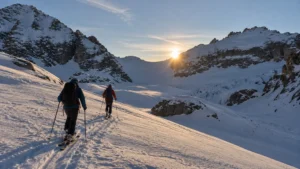
The alarm goes off early—sometimes before 5. The mountain asks that you move with first light, when the rock is more stable and the weather more predictable. The first stretch is a fixed-rope path leading to Colle delle Sagnette, an exposed section assisted by chains. Then you drop into Valle Varaita and switch sides. Now the real adventure begins.
The first goal is Bivacco Andreotti, at around 3225 m. You climb through endless scree and rocky steps. The trail isn’t always clear, and the ground is often unstable. There are no technical sections yet, but the continuous effort wears you down.
From the bivouac onwards, you gear up with harness and rope. This is where the alpine terrain begins. You enter the land of legendary names: Passo del Gatto, the “Dining Room” (a natural terrace where many stop for a snack), the Duomo di Milano, the “Furnaces”.
Beneath Testa dell’Aquila, an exposed but secure traverse leads to the East Ridge. Here, another route merges in—more technical, more dramatic. The summit isn’t far: the final metres are on loose rock, and then you reach the cross.
A View That Speaks for Itself
From the top of Monviso (3841 m), the view is endless. To the east, the entire Alpine arc unfolds. On clear days, you can spot Monte Rosa, Mont Blanc, even Gran Paradiso. But the real jaw-dropper comes when you look south, towards Liguria: with a bit of luck, you’ll glimpse the Ligurian Sea. Mountain and sea in the same view—it’s a powerful contrast.
The summit, narrow and unwelcoming, demands your full presence. There’s no room for distractions. It’s a moment that doesn’t last long, but it stays with you forever.


The Descent Doesn’t Forgive
You descend the same way you came up. And it’s no formality. With tired legs, unstable terrain, and downclimbing sections that demand attention, it’s easy to slow down. The full trip (up and down) often takes more than 9–10 hours. A proper test, even for the fit.
That’s why Monviso should never be underestimated. The length of the route, the altitude, the technical ground, and the overall physical effort make it comparable to a 4000er. You need to be fit, mentally sharp, and comfortable on rock.
When to Climb
The best months are August and September. Late summer offers more stable conditions, less residual snow, and longer days. July is already possible, but you might still encounter snow patches. June? Too early—unless you’re experienced and properly equipped. After September, the mountain changes face: the cold returns, and you’ll need winter gear.
Who Is This Climb For?
You don’t need to be an expert alpinist—but it’s not a walk in the park either. The Monviso ascent is ideal for advanced hikers who want to challenge themselves on mixed terrain, in a roped team, with some grade II climbing. It’s for those who love the “classic” mountain experience: proper fatigue, real elevation gain, sweat, and views that etch themselves into your soul.
It’s a mountain you can fall in love with—but only if you’re willing to earn it.
Ready to book your Monviso ascent?
Take on the Stone King with an expert alpine guide by your side. No shortcuts—just rock, silence, and a summit you’ll have to earn.
Clik here now and start planning your real mountain adventure.
From Monviso to Monte Rosa: Meet the Author
Luca “Cava” Avagnina is an alpine guide, land surveyor and passionate writer. Born in 1993 and originally from Ceva (CN), Monviso is his home turf—he knows it like an old friend, climbed and told in every season. He often works on Monte Rosa, but always returns to “His Majesty the Viso”, which remains his mountain of the heart. Lively, direct, a bit of a poet—if you meet him on the wall, you’ll know him by the smile, and that contagious joy for living the mountains to the full—naturally, without heroics, but with joy. His motto? Stai sereno (“Keep calm”). And it’s impossible not to, when you’re roped up with him.