The Lyskamm Nose is one of those places that often return to my thoughts, even when I’m at home, with my hands among the beehives, checking the trout tank or simply sitting on the terrace.
It’s strange how some mountain climbing lines remain in your head even when you’re down in the valley and the season changes.
The Lyskamm Nose is not a famous peak like the Lyskamm or the Margherita, but in its own way it is a threshold.
When I had just finished my aspirant guide course, the Lyskamm Nose seemed to me like a first step to understand what it really meant to accompany passionate mountaineers into the heart of the Rosa for the first time, experiencing Monte Rosa with intensity and awareness.
40 years ago, the traverse of the Nose was much quieter than now…
A snow slope took you zigzagging to the summit… a small 4000… a journey into the center of Monte Rosa.
A route that requires mental presence
The Lyskamm Nose is climbed via the Quintino Sella Refuge.
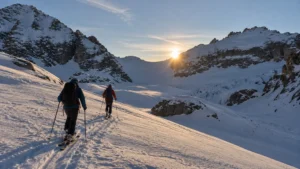
You start around four-thirty. The track leading to the base of the Nose is not difficult, but requires attention.
The sounds are those I carry home: crampons creaking on hard snow, breathing becoming regular, a carabiner hitting against the harness, the dawn light igniting the sky.
Under the south face of the Lyskamm you look up at any climbers on the vertiginous summit ridge.
In the amphitheater you cross at the base of the Lyskamm, you can watch while walking as the plain lights up, or the summer heat that remains crushed down there, where you left your worries.
Sometimes I point to a distant spot, to remember where we come from… breathe slowly, let your head empty and your eyes do the rest.
The technical difficulties of the ascent
The summit of the Nose is at about 4150 meters; the altitude hasn’t changed, but the climbing route has become year after year decidedly more challenging compared to my first memories.
At 3800 meters you currently face some rocky sections for 150 meters of elevation that lead to the final slope: an inclined snow face, 35/40 degrees, a section that puts everyone in line with their own thoughts.
With hard snow you climb well; if ice appears, crampons must be used front-pointing, putting your calves to the test.
Listen to the sensation of being on your toes on crampons, the slope that forces you to distribute your weight correctly.
The silence of the summit
When you arrive on the summit ridge of the Nose, fatigue gives way to a different silence.
There are no great summit shouts: you look at each other, maybe a photo, a hand on the shoulder.
What remains is not the photo, but that suspended moment when you realize that you don’t need to give sound volume to thoughts.
The panorama always changes: sometimes you see Mont Blanc, the valleys of Gressoney and Ayas, the Margherita that seems within reach.
Other times it’s a sea of clouds below you covering everything.
Towards the Capanna Margherita
The descent towards the Capanna Gnifetti to face the ascent to the Margherita the next day is liberating.
The altitude has entered our body… tomorrow everything will be lighter.
If instead you decide to climb the Margherita directly to spend the night there, the route still requires good energy: you find it hoping to be in the refuge to fill your eyes with the highest sunset in Europe, with the safety of a warm shelter and trusting in an equally magical dawn.
A transforming relationship
To those who ask me “for you, mountain guide, these things are ordinary… Don’t you get bored?” I answer: I have thousands of photos of shadows, lights and clouds that are always different… and each time is different, since you are different people each time… you make each time I climb up here unique.
We are all subjects that interact with each other: after these experiences, none of us is the same anymore.
Climbing the Lyskamm Nose is not the highest peak of the Rosa. It’s not even the most famous: it’s a threshold.
Certain thresholds must be crossed slowly, with precise steps, few words and a permeable mind.
Once back in the valley, you open the door of your home, take off your backpack, look at the dawn of the next day, but the emotion doesn’t fade from your mind.
You dream of leaving again.
Experience the Lyskamm Nose with our guides
What you’ve just read isn’t just a story: it’s an invitation.
The Lyskamm Nose awaits you, with its airy ridge and silences that change your perspective.
Our IFMGA mountain guides from Monte Rosa don’t just take you to the summit: they accompany you in an authentic dialogue with the mountain.
With us, you’re never alone. Every doubt finds an answer, every step is secure, every moment is lived with the awareness of those who truly know what it means to be up there.
Ready to live this experience? The mountain is waiting for you.
Discover our Lyskamm Nose programs
Lyskamm Nose: meet the author

Ioris Turini is an IFMGA mountain guide and Monterosa Booking ceo.
Born in the plains of Montanaro, he found his home and life philosophy in Monte Rosa.
When he’s not on the rock face guiding climbers, he tends to his beehives and trout farm, cultivating the same patience and attention he brings to the mountains.
He lives mountaineering as an art of transformation, inspired by Japanese kintsugi: the art of repairing fractures and making them precious.
For him, the mountain is never conquest, but silent dialogue with oneself and nature, where every ascent becomes an opportunity for inner growth.