Intro
Mountain safety is one of the most important topics to discuss, yet one that is never discussed enough.
“With the mountain guide, shouldn’t I be 100% sure?”
The answer is uncomfortable but necessary:In the mountains, absolute safety does not exist.
And anyone who tells you otherwise is lying to you.
This is not a premise to scare you, but to make you understand what it really meansgo to the mountains with awareness.
And because, despite everything, the mountain guides remain your best ally up there.
The mountain is not a playground
Let’s get straight to the point about mountain safety: the mountain is intrinsically dangerous.
Hidden crevasses, weather conditions that change in a matter of minutes, rocks that fall, snow that gives way underfoot.
These are not inconveniences that you can avoid by planning the climb, preparing, and training, but they are an integral part of the mountain environment, adventure, and mountaineering.
Climbing with an Alpine Guide will always allow you to have more safety when climbing, but remember thatEven if you follow all the procedures, the final word belongs to the mountain.
The objective risks that no one can eliminate
Crevasses: Even the most well-trodden glacier can hide dangers. Snow bridges can collapse even under the weight of a light, experienced person.
Weather conditions: A clear morning can turn into a storm in an hour. And up there, there’s nowhere to hide.
Falling rocks: The mountain is constantly moving. A rock (or a shower of rocks) falling at 3,000 meters doesn’t take anyone in stride.
Human factor: Even the most experienced climber can make a mistake. Fatigue, distraction, or underestimating a route.
Altitude: Above 3,000 meters, your body works under extreme conditions. And it can react unpredictably. (Read here: altitude sickness: how to prevent it)
These risks cannot be eliminated. They can only be managed, reduced, and addressed with expertise, and the UIAGM Alpine Guides are the best in this field.
But eliminating it altogether? Impossible.
Why go with a mountain guide?
“If absolute mountain safety doesn’t exist, why choose a UIAGM-certified mountain guide?”
The answer is simple: because it drastically reduces risks and teaches you how to manage the unavoidable ones.
What a mountain guide really does for your safety
Read the mountain: Recognizes danger signs you would never see.
Choose the safest route: he knows the mountain, every exposed passage, every risk area.
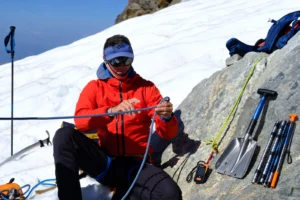
It teaches you how to move: It doesn’t just take you to the top, it teaches you how to get there. How to walk roped together, how to use an ice axe and crampons, how to react in the event of a fall.
It is prepared for the emergency: knows how to organize a rescue, how to immobilize a fracture, how to manage an evacuation.
The three levels of mountain safety
When we talk about safety in the mountains, we must distinguish three different levels.
1. Preventive safety: avoiding avoidable risks
This is the preparation: physical training, technical knowledge, adequate equipment, study of the conditions.
That’s the part that’s up to you. And there are no excuses here.
If you are not trained, if you don’t know the basic techniques, if you don’t have the right equipment,you are increasing the risks unnecessarily.
2. Active safety: managing risks during activity
This is the competence: knowing how to read the mountain, making correct decisions, moving with technique, reacting to changes.
This is where a mountain guide makes the difference.
3. Passive safety: managing emergencies when they happen
This is the response to the accident: rescue, first aid, evacuation.
It’s the part you hope you never have to use.
But when it needs to, it has to work perfectly.
And in this case only a skilled Alpine Guide can help.
How to choose true security
Personal preparation: your first duty
Physical training: a tired body makes mistakes. A prepared body has more margins of safety.
Technical training: attend mountaineering courses, learn the basic techniques, practice in controlled environments.
Knowledge of the environment: Study the conditions, weather, and specific risks of your destination. In our Whatsapp Channel we’ll give you update about this.
Appropriate equipment: you don’t need the latest model, you need equipment that works and that you know how to use.
Choosing a guide: not all are the same
UIAGM Certification: It’s the only international guarantee of competence. Don’t compromise.
Local experience: an expert local guide not only accompanies you but also shows you the right path.
Accepting risk: the maturity of the mountaineer
The paradox of mountaineering is this: To go to the mountains safely, you must accept that absolute safety does not exist.
Only when you accept this paradox can you:
- Prepare yourself properly
- Move with the right attention
- Making informed decisions
- Respect the mountain for what it is
Why we keep climbing despite everything
“But is it worth it if mountaineering is so dangerous?”
The answer is yes. But it must be a conscious response.
The mountain offers experiences you can’t find anywhere else:the deep silence, the pure beauty, the confrontation with your limits, the discovery of strengths you didn’t know you had.
But he offers them to you only if you deserve them. If you face them with respect, preparation, and humility.
And above all, if you accept that zero risk does not exist.
Choose your mountain with awareness
If after reading this article you still want to climb with us, it means you’ve understood what it really means to experience the mountains.
We don’t promise you absolute security. No one should.
We promise you competence, experience, preparation.
We promise to always tell you the truth: about the risks, the conditions, your limits.
And we promise that, if you prepare yourself and respect the mountains, you’ll bring home experiences that will change your life.
The mountains aren’t for everyone. But if they are for you, we’re here to guide you toward the best version of yourself.
With head, technique and heart.
And if you have any doubts, fears, or questions: write to us.