We live in a time when everything seems to accelerate.
Technologies evolve rapidly, artificial intelligence enters work processes, automates tasks, suggests decisions, and analyses data. Many of the things that until a few years ago required time and experience are now solved in a matter of seconds.
It is therefore natural to ask which skills will truly matter in the future.
A few days ago I listened to a video by Marco Montemagno reflecting precisely on this topic: how to approach the coming years in the age of artificial intelligence.
For those who would like to watch it directly, here is the video.
We liked it very much because it touches on an essential point: in the world that is coming, it will no longer be enough to simply execute tasks.
Montemagno suggests that the most important competence will become the ability to bring together different tools, connect knowledge, coordinate skills and make decisions when variables change.
A bit like what an architect does when designing a complex structure, or what a conductor does when harmonising different instruments.
While listening to these words, something curious happened.
We kept thinking about mountaineering.
Not because the video talked about mountains, but because the way the future was described strongly resembled what people learn when they start moving in high mountains and begin developing real mountaineering skills.
Disposable Forks and Swiss Army Knives
In the video, Montemagno uses a very effective metaphor to explain the type of skills that will be needed in the world that is coming.
The risk, he says, is becoming a disposable fork.
A disposable fork serves only one function. You use it and then throw it away.
As long as the context remains exactly the same as the one it was designed for, it works perfectly. But when the context changes, that single function is no longer enough.
The same can happen to people when they build their skills around a single repetitive ability.
In a world where many activities can be automated, a competence that is too narrow risks becoming easily replaceable.
The alternative is to become a Swiss Army knife.
A tool that does not perform only one function, but many. It is not perfect at one single task, but it is capable of adapting to different situations and solving different problems over time.
The tool with a blade, screwdriver, scissors and bottle opener is in the backpack of almost every mountaineer. It may not be the perfect tool for every specific function, but it becomes incredibly useful precisely because it can adapt.
Anyone who begins to spend time in the mountains soon realises that a single skill is never enough.
You need to walk well, orient yourself, read the weather, move on ice, manage the rope, interpret the terrain and make decisions when conditions change.
These mountaineering skills are rarely learned all at once.
Every experience adds another element.
At first you simply learn how to walk in the mountains. Then come the first treks. After that, the glacier. With time comes rope progression. Eventually a more exposed ridge.
Over the years you do not build just one skill.
You build something far more interesting: a system of competences that work together. Real mountaineering skills that allow you to adapt to changing environments.
And this is precisely what makes mountaineering such a contemporary school.
Motivation and System
Motivation, in life, in work and also in mountaineering, is the initial spark.
It is when you see a mountain and think:
“I would like to be up there.”
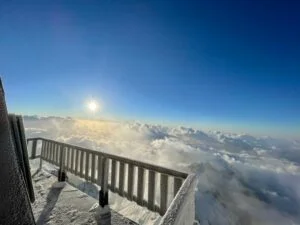
A photo of the Capanna Regina Margherita.
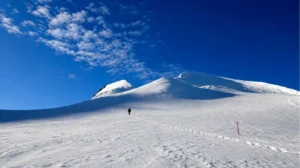
A ridge of the Monte Rosa illuminated by the morning sun.
The story of someone who has just returned from a climb.
For a few days that idea occupies space in your mind and feels possible.
But motivation is unstable.
It arrives easily and disappears just as easily.
What truly allows growth over time is the system.
A system made of several elements working together: habits, method, experience, environment and people with whom you share the journey.
When the system is well built, even if one variable weakens – for example motivation – the path continues.
In the mountains this principle is very clear.
No one reaches a great summit through a sudden burst of enthusiasm.
You begin with walks.
Then come the treks.
Then the first glacier.
With time you learn rope progression.
Only afterwards does a higher summit arrive.
Each step builds something.
Each step helps develop deeper mountaineering skills and a stronger relationship with the mountain.
It is not a quick race. It is a process.
The World Runs Towards the Future
Many decisions that once required time and experience can now be made in a matter of seconds. Accelerating seems to have become the right formula.
But the time of nature is made of cycles and processes. It has another dimension. It is not fast or slow in absolute terms: those categories belong to the human way of perceiving time.
The mountain simply lives in its own time.
Snow has its rhythms.
The weather changes when it wants.
Temperature rises or falls without being controlled.
In the mountains you cannot accelerate time. You can only learn to read it.
Understanding the snow.
Interpreting the weather.
Feeling the rhythm of the rope team.
Recognising fatigue.
These abilities form the core of real mountaineering skills, learned slowly through direct experience in the mountains.
The mountain forces you to slow down enough to truly understand what is happening. It obliges you to pay attention. And that is a quality that is becoming increasingly rare and increasingly necessary.
The Rope Team
Much is discussed today about the relationship between humans and technology, often described as a competition.
In reality, the most effective systems – as Montemagno suggests and as mountain experience shows – almost always arise from the collaboration of different competences.
In the mountains this principle is natural.
A rope team is a small moving community.
The guide brings experience, the ability to read the environment and manage risk.
The climber brings energy, concentration and the willingness to learn.
The environment contributes its most important part: variables that change continuously.
Safety emerges precisely from this relationship.
The guide does not climb the mountain for you.
And you do not see the mountain with the eyes of the guide.
But together you become a system capable of moving correctly within that environment.
A rope team is also a place where mountaineering skills develop and where real mountaineering experience grows.
And it is precisely within this relationship that everyone evolves.
The climber grows.
The guide refines their judgement.
The rope team becomes stronger.
The mountain watches generations pass.
In this way a virtuous system is created, where each experience improves the next.
The Future Born from Ancient Gestures
In the end, that reflection on artificial intelligence left me with a very clear feeling.
While the world seems to rush toward the future, some of the most useful competences appear to come from very ancient gestures: observing, understanding the environment, building experience over time.
The mountain – and Montemagno’s reasoning – reminds us of something simple.
Human beings are not disposable tools.
We are not a single function.
We are a combination of different capacities working together.
And that is precisely the meaning of the future.
In the age of artificial intelligence, the mountains remain an incredibly modern school because they train exactly what machines cannot replace: judgement, presence and the ability to adapt to complex situations.
That is exactly what strong mountaineering skills teach over time.
If you have learned something from the mountains, the world that is coming does not feel frightening.
Because the school of the mountains has already taught you how to move within complex systems.
Once they were glaciers, ridges, weather and ropes.
Tomorrow they will be algorithms, machines and new tools.
But the principle remains the same.
Keep learning.
Develop your mountaineering skills.
Learn to adapt.
Continue to grow.
Just as you do when you begin to climb.