The Quiet Change More and More People Are Experiencing
It is something simpler: the need to rediscover a different rhythm — more continuous and more tangible — in a time when attention and time itself feel increasingly fragmented.
Many arrive with the same question, even if they rarely express it openly: is this the right moment to start moving again, properly and without improvisation? Behind this search, the connection between mountains and mental wellbeing is becoming increasingly clear.
Since Covid, this shift has become particularly visible. Today, many people look to the mountains for what daily life has gradually reduced: uninterrupted time, real physical movement, and a quality of attention that has become increasingly rare. The alpine environment once again becomes a concrete space capable of restoring balance within rhythms that have grown progressively more intense.
Those who come to the mountains often lead demanding lives filled with responsibilities and constant decision-making. At a certain point, it becomes clear that simply stopping is no longer enough to recover energy. Remaining active becomes a conscious choice — necessary to maintain clarity and long-term stability.
Between work and daily organisation, attention remains engaged for hours; by the end of the day, the mind struggles to slow down and recovery becomes less immediate. Passive rest is rarely sufficient. Instead, there is a growing need for an activity that truly involves both body and mind, without pressure or competition, where movement and concentration progress together again.
At its core, the search is simple: normality. A more natural rhythm, less digital and more grounded. Time experienced with presence, real relationships and genuine dialogue — a way to feel fully engaged in what one is living.
For this reason, more and more people choose to return to the mountains with professional guidance, transforming their return into a gradual and conscious journey.
When the Rhythm Changes
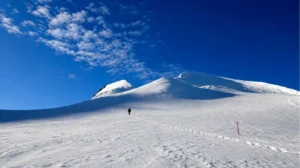
In the mountains, rhythm changes naturally. Walking, breathing and observing the terrain bring attention back to essential actions. After only a few hours, mental energy stabilises and the typical dispersion created by digital routines begins to fade.
This is when many people start to experience the mental benefits of the mountains in a tangible way. There is no need to actively seek disconnection; the environment itself creates mental space, naturally reducing the cognitive overload accumulated in everyday life, a benefit increasingly recognised by research on nature and mental health.
The alpine environment requires presence and measure. Every decision arises from observing conditions and managing personal energy. The mountains reward consistency rather than speed, allowing even those returning after years focused primarily on work to rediscover a sustainable pace.
The alpine environment requires presence and measure. Every decision arises from observing conditions and managing personal energy. The mountains reward consistency rather than speed, allowing even those returning after years focused primarily on work to rediscover a sustainable pace.
Often, the hardest step is not the ascent itself, but understanding where to begin. Having an experienced professional alongside you allows the experience to unfold without the burden of managing everything alone.
👉 Would you like to start gradually?
Discover our Mount Rosa Basic Mountaineering Course → Clik here
Moving with Experience
Approaching mountaineering requires a different kind of attention from everyday life. Progression, adaptation and reading the environment become integral parts of the experience. It is not about proving something, but about learning to move with awareness — recognising personal limits while maintaining a safe margin.
It is precisely this margin that contributes to mental wellbeing: it reduces performance anxiety and allows the experience to be lived with greater calm and clarity.
The mountain guide becomes the bridge through which people gradually enter a more conscious way of moving. Rhythm, observation and responsibility regain their central role, restoring a more balanced relationship with time and personal energy.
Even fatigue takes on a different meaning. It sets the pace of the day and brings a clearer perception of one’s resources. After a day at altitude, many describe simple yet concrete sensations: deeper sleep, fuller breathing and greater mental clarity the following day.
→ Discover guided ascents on Monte Rosa → Clik here
What Participants Often Share
- The mind clears effortlessly.
- I feel more present from the very first day.
- I return home with more energy than when I left.
These reflections appear consistently and show how closely mountains and mental wellbeing are connected. The effect does not depend on performance, but on the natural shift in rhythm created by the mountain environment.
Many people realise that changing their entire lifestyle is not necessary to feel better. Introducing real, meaningful moments throughout the year — built around the right pace — is often enough.
Rediscovering Balance Over Time
This is why more people are choosing outdoor activities: they offer what daily life often lacks — continuity, full attention and genuine movement.
The mountains become a space for regeneration through action. An environment that allows people to remain active over time and regain balance without force or pressure.
It is not about doing something extraordinary, but about consciously choosing how to invest one’s time and energy.
👉 When was the last time you dedicated time to something that required only presence and movement?
If this feels like the right moment, you can explore guided experiences on Monte Rosa → Clikl here
Frequently Asked Questions
Do I need previous experience to start going into the mountains?
No. Many people begin after years away from alpine environments, choosing gradual activities supported by qualified mountain guides.
Do I need to be very fit?
A good general level of fitness helps, but programmes are adapted to each participant’s actual level.
Why do the mountains help mental recovery?
Because they require continuous, practical attention, naturally reducing mental overload and distraction.
What is the best way to start?
A basic course or a first guided experience allows you to learn essential skills safely and progressively.
Is mountaineering only for experienced climbers?
No. There are programmes specifically designed for those approaching the activity for the first time.
What benefits do people usually notice after a high-altitude experience?
Greater mental clarity, deeper sleep and a lasting sense of balance that often continues in the days that follow.