Your first 4000m entry level peak goes far beyond choosing the most photogenic summit. It’s about honesty, preparation, and respect for the environment you’re stepping into.
In this guide, you’ll find:
- how to choose the right 4000m peak for your level
- which summits make sense as a first experience
- how to avoid the classic mistake: letting enthusiasm outrun preparation
The Questions You Need to Ask Yourself First
Before looking at the mountain, you need to look at yourself — and there is nothing philosophical about it. These are practical questions.
The right first 4000m is not the one you wish you could climb, but the one you’re genuinely ready for today.
1. What experience do you actually have?
Ask yourself:
- Have you already walked above 3000m?
- Do you know how your body reacts to altitude?
- Have you used crampons and an ice axe?
- Have you moved on a glacier before?
- Have you slept in a high-mountain hut?
- Can you manage roughly 1000 m of ascent in about 3 hours without finishing destroyed?
If the answer is “no” to most of these, start with something that helps you learn without pushing you into a wall.
If you already have a few relevant outings behind you, you can move a step higher.
2. How much time do you have to prepare?
Climbing a first 4000m peak peak requires training.
If you have months ahead, you can build a solid base:
- hikes above 3000 m
- a basic mountaineering course
- a couple of preparatory ascents
If you only have two spare weeks, you need to choose based on your current level — not the level you hope to have.
3. What do you want to learn?
Your first 4000m peak is a classroom. What’s your goal?
- gaining confidence with crampons
- understanding how you react to altitude
- learning to move on a rope
- managing effort at high elevation
- getting familiar with glacier terrain
Choosing the right summit means choosing the right lesson for where you are now.
The 4000m Peaks That Actually Make Sense (and Why)
Not every 4000m mountain works as a first experience. These do — for clear, practical reasons.
1. Punta Giordani (4046 m)
A perfect starting point. A relatively short ascent (around 700 m from the lift station), real glacier terrain, steady slopes.
Ideal for learning to:
- use crampons and harness
- move on a rope
- find your rhythm above 4000 m
2. Breithorn West (4165 m)
The classic accessible 4000m. You start from Plateau Rosa (3480 m) and follow an easy, linear route across the glacier.
Great for:
- understanding how your body reacts above 4000 m
- getting a feel for glacier travel
- experiencing a “proper” summit without an exhausting climb
3. Piramide Vincent (4215 m)
A brilliant first 4000m, on the same level as Giordani and the Breithorn. No technical difficulties, consistent glacier terrain, regular slopes.
The difference? It’s longer, so you need more stamina.
From Indren (3275 m) you climb broad glaciers, with visible crevasses and a steady progression to the top.
Perfect for learning to:
- maintain a constant pace for several hours
- manage your effort high on the mountain
- move confidently on long stretches of glacier
Ideal if you’ve already been above 3000 m and want a classic glacier ascent without technical complications.
4. Gran Paradiso (4061 m)
A full, meaningful, much-loved 4000m climb.
You start from Rifugio Chabod or Rifugio Vittorio Emanuele II and reach the summit in 4–5 hours: longer and more continuous than Capanna Margherita, even though the altitude is lower.
Expect a mix of:
- moraines and good paths
- a glacier with visible crevasses
- a short rocky ridge up to the Madonna summit statue
A great way to experience every aspect of a 4000m climb.
5. Capanna Margherita – Punta Gnifetti (4554 m)
The dream. It can be a first 4000m — but only if you have a solid fitness base and a bit of acclimatisation.
The environment is powerful: wide glaciers, huge horizons, and the unmistakable atmosphere of real high altitude.
The ascent is not technical, but it’s long and at significant altitude. You need:
- good pace management
- clarity of mind
- some experience above 3000 m
A rewarding summit that asks for proper preparation.
The Most Common Mistake: Choosing with Your Heart Instead of Your Head
It happens all the time: you see a photo, fall in love with a peak… and decide “that’s the one”.
There’s no real experience, no proper training, no awareness of what high altitude truly asks of you.
The outcome can easily be:
- a miserable day
- a retreat
- or, in the worst cases, a real problem
The mountain won’t adjust to our wishes. We have to build the right path so that we are ready for her.
This means choosing the summit that fits who you are now, rather than the most famous name on the list.
How to Prepare Properly
Even the “easiest” 4000m becomes complicated if you show up unprepared.
Start with the basics
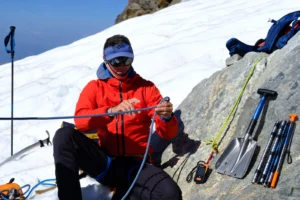
If you’ve never used crampons, an ice axe or walked on a glacier, the first step isn’t booking a summit — it’s learning how to move safely.
A basic mountaineering course teaches you:
- how to use your equipment
- how to move on a rope
- reading the terrain
- managing altitude
- glacier progression
Often it includes a high-mountain ascent — sometimes even to Capanna Margherita — giving you a real, structured approach to your first 4000m.
→ Book your guided ascent on Monte Rosa
In Summary
Your first 4000m depends on three things:
- your real experience
- the time you have to prepare
- what you want to learn
Quick guidance:
- no experience → Punta Giordani or Breithorn West
- fit and already trained → Piramide Vincent or Gran Paradiso
- experience above 3000 m and good pace (1000 m in 3 h) → Capanna Margherita
A first 4000m is more than a trophy; it’s a step in your growth as a mountaineer. Choose it with clarity, prepare with intention, and avoid improvisation.