It’s a technical, almost surgical sensation unlike anything you’ll experience on rock, and it surprises anyone who feels it for the first time. You realise that it’s not about brute strength, but precision and movement.
Every well-executed movement makes the climb smoother. The climb becomes a balance of focus, calm and control.
For beginners, icefalls are an ideal starting point for winter mountaineering: you learn at your own pace with the safety of an expert guide.
Why climb with a IFMGA Guide?
Without a guide, the two most common mistakes are random swings and ‘arm climbing’.
A IFMGA Mountain Guide will immediately set you on the right track, teaching you to make light swings in the right spots, to place your feet instead of kicking them up, and to move cleanly and relaxedly. However, the most important aspect is what you won’t see in videos.
Ice is not just ‘a pretty line to photograph’: suspended slopes, wind, night-time refreezing, temperature changes and the quality of the ice all make the difference between a perfect day and a potentially dangerous one.
IFMGA guides know how to read all of these factors. This is what distinguishes a professional course from a simple attempt.
The ideal location
- Cogne: iconic, refined, rhythmic and varied — perfect for a first approach.
- Gressoney: more alpine, quiet, and concrete.
- Alagna – Otro: authentic Monte Rosa, essential and powerful.
These valleys offer different yet complementary environments, which are ideal for those who truly want to learn how to move on ice with technique and awareness.
When it’s the best moment?
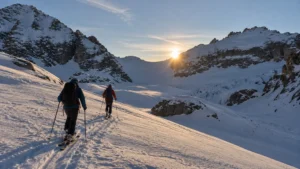
The best time to go is as soon as the cold arrives and the ice forms and stabilises. January is the most reliable month: the cold makes icefalls solid and predictable, days are longer, and conditions are ideal for learning calmly and safely.
What you’ll learn
- How to position your feet correctly to save your forearms.
- Placing an ice screw properly.
- Telling good ice from detached or rotten ice;.
- Reading the environment and knowing when it’s time to stop.
This course focuses on technique and perception: after two days like this, you will never look at the winter mountains the same way again.
Equipment to get you started
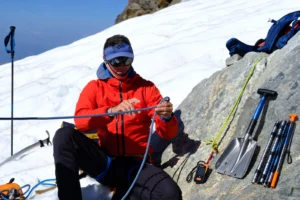
You don’t need to buy anything as we provide technical ice tools, crampons, a helmet and a harness. However, if you would prefer to have your own set, Petzl, Grivel and Black Diamond are renowned for their safety and quality.
GO / NO-GO: the mountaineering culture
Not every icefall is suitable every day. If conditions aren’t optimal, you change aspect or valley. If the ice isn’t safe, the date will be changed. Sometimes, the most technical decision is precisely not to climb.
This is true mountaineering culture.
Who is an ice climbing course for ?
It’s for those who are curious and want to experience how precise movements can change everything.
It is also for those who want to take their first steps into vertical mountain terrain in a safe and controlled way.
No rock-climbing experience is necessary, just a good level of fitness.
And if the weather changes
You don’t push it. You adapt. The priority is always terrain quality and group safety.
Do you really want to try it?
We offer a dedicated ice climbing course for beginners, combining technique, verticality and practical learning over two intense days.
👉 Discover the ice climbing course
Course Program
Day 1 – Introduction to climbing techniques
Meeting at 9 am at the chosen location, followed by an introduction by the Mountain Guide.
Session in an ice-climbing area: gear presentation, knots, anchors, screws and basic top-rope progression.
We work on fluidity, precision and posture.
After checking in at the refuge or hotel, there will be an evening discussion about mistakes and sensations.
Day 2 – Real icefall and multi-pitch progression
We move to real terrain. You will put what you have learnt into practice and experience verticality in complete safety.
It’s an intense day of focus and control, with the direct assistance of IFMGA guides throughout.
Two days of learning. Two days that will stay with you.