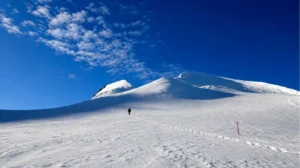
For many people, Mont Blanc represents a transition point. It is the moment when mountaineering shifts from “trying” to doing things seriously, taking responsibility for choices made along the way. Learning how to prepare for climbing Mont Blanc with a guide is often where this change becomes concrete. Mont Blanc cannot be improvised. Fixing a date is not enough. What matters is preparation and the ability to recognise the right moment
Who Thinks About Mont Blanc (and Why It Is Not a Simple Choice)
If you are considering Mont Blanc, you are usually already fit and have some experience above 4000 metres. You may have climbed Punta Giordani, Breithorn, perhaps even Capanna Margherita. The foundations are there.
The real concern is rarely physical strength alone. More often, it is the fear of realising too late that something was underestimated: arriving underprepared, misjudging a section, or forcing a decision that should have waited.
The Summit Matters, but It Is Not the Only Thing at Stake
Reaching the summit is still central, but it is not the only element in play. Alongside the top, there is the need to feel up to the task, to live an experience that makes sense, and to return home without the doubt of having rushed the process.
On Mont Blanc, the summit carries more weight than on many other high-altitude mountains. Elsewhere, the experience can still be meaningful without the top. Here, the confrontation is more direct. Shortcuts disappear, and every lack of preparation becomes evident.
The Most Common Mistake: Wanting to Do It Without Preparing It
The most frequent mistake is wanting to “do Mont Blanc” without truly preparing it.
Many arrive with good general fitness, but without solid glacier experience, without natural use of crampons and ice axe, without a deep understanding of their own limits. The signs appear quickly: irregular pace, early fatigue, frequent requests for breaks, sometimes already during the approach to the hut.
Going to Mont Blanc or Preparing Mont Blanc
This is the real difference.
Going to Mont Blanc means fixing a date and aiming straight for the summit. Preparing Mont Blanc means building a path: climbing other high-altitude peaks, making crampon and ice axe use automatic, handling significant elevation gain, and observing how the body responds when fatigue accumulates.
Without this work, Mont Blanc simply does not work.
What Truly Surprises on the Mountain
The first thing that surprises most people on their first Mont Blanc attempt is the continuity of effort. There is no moment where you can think “it’s done”. The climb is long, technically accessible but relentless, requiring focus from start to finish.
This is why timing and route choice directly shape the experience.
From the French side, via the Goûter route, July is often the most balanced month. Long days and very early dawns allow smoother time management. June can still hold excessive snow, while August may present dry and exposed sections, especially below the Goûter, demanding more attention.
From the Italian side, via the Gonella route, the character changes completely. The ascent is longer and more demanding overall, with a more isolated environment and continuous progression. It requires stronger preparation and greater clarity, and for this reason it is reserved for those with solid margin. It is not an alternative to the Goûter, but a different, more complete experience, to be evaluated carefully based on the person, timing and conditions.

From Monte Rosa to Mont Blanc: The Progression That Works
Preparing Mont Blanc properly means following a logical progression.
Preparation begins well before the climb itself. A good physical base is essential, but so is real altitude experience. First 4000-metre peaks such as Punta Giordani or Breithorn are useful mainly to develop rhythm and altitude awareness.
Capanna Margherita enters early in the path because it allows serious work on endurance and acclimatisation. Polluce and Castore come later, adding technical demands and sustained effort. Lyskamm and the ridges belong to a later stage; they do not prepare Mont Blanc, they come after, once the foundations are solid.
When You Can Say You Are Ready
Readiness is never defined by a single performance.
What matters is the consistency shown on previous climbs, the way technical equipment is used, and the solidity maintained even during the descent. A useful training reference is being able to climb around 1000 metres of elevation in about two and a half hours with a backpack, knowing that times will inevitably slow at altitude.
Training and Technique: The Invisible Foundation
From February to June, the structure of training is simple, but it requires consistency.
Running or cycling with elevation gain, long mountain hikes on foot or skis, and steady endurance efforts build the physical base. Alongside this, technical competence allows no shortcuts: crampons must feel natural, rope management must be autonomous, and spacing in a rope team must be instinctive before thinking about Mont Blanc.
The Less Visible Part: Clarity and Observation
Preparation is not only physical.
It is about clarity under fatigue, the ability to observe yourself when pace drops or conditions change. Sometimes a single climb, like Capanna Margherita, provides clear answers. Other times, it takes several steps. There is no fixed rule. There is observation, over time and in real terrain.
What We Guarantee, Regardless of the Summit
The most honest promise we can make is clarity.
We are clear about real possibilities, without creating illusions. Beyond the summit, the objective remains the same: to live a coherent experience, built on good decisions, attention and respect for the path.
This is measured on the mountain, at the end of the climb, when tension fades and only what truly matters remains. And it is there that, more often than expected, a simple sentence sums it all up:
“Thank you. Without you, I would not have made it.”
The First Step
The first step is not booking a climb. It is understanding whether this is your moment.
If you are considering Mont Blanc and want to understand which path makes sense based on your experience, whether the Goûter or our favorite Gonella route is more coherent for you, write to us. We help you prepare Mont Blanc properly, step by step, from preparation to ascent.