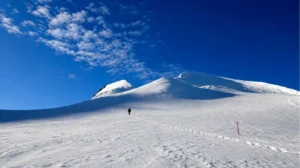
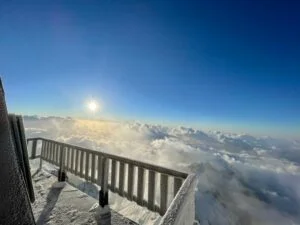
The mountains do not become harsher; they become more essential. And they ask for attention.
Winter vs summer mountaineering
Those who spend time in the mountains throughout the year know this well. Winter mountaineering is not the natural continuation of summer mountaineering, but a distinct environment with its own rhythms, rules and priorities. Peaks keep the same names, ridges remain the same, yet we read them differently. Distances feel different, timing shifts, decisions take on more weight. Above all, the relationship between the climber and the surroundings changes.
Winter arrives without asking permission. It does not announce itself or knock at the door. It simply changes things. Daylight fades, paths disappear beneath uneven snow, many huts close for the season. The mountains take on a different shape, more compact, more restrained. What is unnecessary falls away, leaving what truly matters. It is often in this transition that mountaineering in winter becomes a way of listening.
The same places, different rules
The winter mountains are a different environment, with their own pace and specific demands. Thinking that familiar routes can be approached simply by adding another layer of clothing is a common assumption, especially for those coming from summer mountaineering experience. The names of the summits remain the same, as do the slopes and faces, but the way one moves, observes and makes decisions changes.
In summer, the mountains tend to guide you. Trails are clear, reference points easy to follow, and there is room to adjust plans along the way. You can slow down, rethink a choice, take a small detour. In winter, the terrain requires greater precision. Each decision becomes clearer in its consequences. Snow erases tracks, smooths out slopes and alters the perception of distance. It is not only the landscape that changes, but the way it must be read — a key difference between summer and winter mountaineering.
Snow, time and the body
Moving in winter means travelling over a living surface. Snow carries the memory of what came before: wind, temperature changes, exposure, and the transformations of previous days. Some snow supports you, some gives way; some makes progress easier, some slows it down. Learning to recognise these differences is a skill built through experience, by careful observation and constant adjustment — an essential part of winter mountaineering skills.
Then there is time, the element that truly shapes the day. In winter, daylight hours are few and precious. Starts are often made in the dark, not in search of sunrise, but to allow enough space for both ascent and descent. The day must be considered as a whole. In summer mountaineering, light lasts longer; in winter, darkness arrives quickly, bringing colder temperatures, stiffer movements and the need to remain focused.
Cold accompanies every movement and works beneath the surface, affecting the body, the sensitivity of the hands, energy levels and even hydration. It requires constant awareness, an ability to recognise small signals and anticipate needs. Dressing well becomes a matter of balance, a continuous adjustment between protection and lightness — a practical difference between winter and summer mountaineering learned only through time spent outdoors.
Fewer supports, more choices
With winter, support points also change. Mountain huts that structure many summer mountaineering routes are often closed and remain only as references on a map. This naturally leads to a more self-reliant approach, based on practical decisions made before setting off: what to carry in the rucksack, what to leave behind, how to plan an alternative if conditions change. In mountaineering in winter, options are fewer and therefore need to be considered in advance.
Reading risk
In winter, avalanches become part of the environmental picture. Not as something to fear, but as a variable to observe. Recent weather, wind, temperature changes and slope exposure all leave traces. The avalanche bulletin offers guidance; the terrain completes the picture. Moving in this context means making gradual, conscious decisions — not to eliminate risk, but to understand it and stay one step ahead.
The avalanche bulletin is part of reading the terrain: consult it here.
Equipment and responsibility
Equipment follows the same logic. In winter, the rucksack tends to weigh more, not only on the shoulders but also in the choices that precede the climb. Tools become more specific, materials more protective, and emergency equipment naturally becomes part of what is carried. This marks another clear difference between winter and summer mountaineering. Every item makes sense when you know why it is there and when it may be needed.
When winter opens possibilities
At this point, the question arises naturally: why choose winter mountaineering. The answer lies in the type of relationship that develops. Less noise, fewer people, fewer distractions. Movements become simpler, decisions slower and more deliberate. You climb less to collect metres and more to remain fully present within an environment that demands attention.
This is why certain winter ascents take on particular meaning. In February, on skis, routes such as Capanna Margherita, Piramide Vincent, Castor and the Gran Paradiso when conditions allow show how high altitude can be approached in winter with logic and balance. Skis allow valleys and glaciers to be linked, enable continuous movement and broaden the perspective on the terrain. The same approach makes it possible, in winter, to look towards Zermatt and imagine itineraries that circle the Monte Rosa massif, connecting different faces and landscapes. When conditions are right, winter mountaineering does not slow things down; it opens possibilities.